P-63 Kingcobra fighter returned from the USSR and inspected by U.S. technicians at Great Falls Air Base after World War II, 1945.
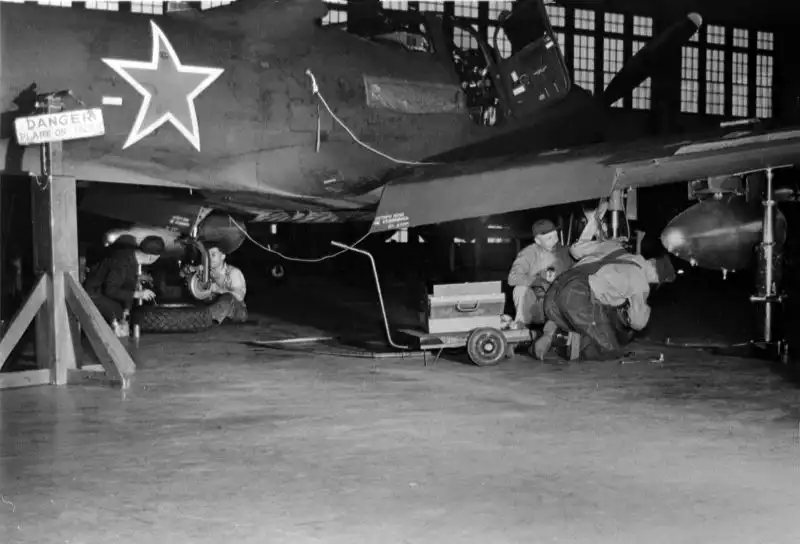
Soviet-Used P-63 Kingcobra Returns to America After World War II
This rare World War II photograph shows a Bell P-63 Kingcobra fighter being examined by American technicians at Great Falls Air Base, Montana, in 1945. The aircraft had previously served with the Soviet Air Force after being supplied through the Lend-Lease program and was among the surviving aircraft processed after the end of the war.
Unlike many American aircraft that became famous primarily through U.S. service, the P-63 Kingcobra found its greatest wartime importance in Soviet hands. More than 2,400 Kingcobras were delivered to the USSR, where Soviet pilots used them extensively during the final years of the Eastern Front conflict.
The Kingcobra in Soviet Service
The Bell P-63 was developed as a successor to the earlier P-39 Airacobra. It featured a more powerful engine, improved aerodynamics, and the same unusual armament layout with a 37 mm cannon firing through the propeller hub.
Although the U.S. Army Air Forces considered the aircraft unsuitable for its own main fighter requirements, Soviet aviation found it much better suited to its operational needs. The P-63 performed well at low and medium altitudes, where many battles on the Eastern Front were fought.
Soviet units used the Kingcobra mainly for air defense, escort missions, training, and ground support during the final stage of the war. The aircraft was appreciated for its heavy armament, strong construction, and ability to withstand combat damage.
Lend-Lease: The Route Between America and the USSR
The aircraft reached the Soviet Union through the famous ALSIB route (Alaska–Siberia), one of the largest logistical operations of the Lend-Lease program. American aircraft were transported through Alaska, Soviet Siberia, and finally delivered to operational units.
Great Falls Air Base played an important role in this system, serving as one of the transfer points where aircraft were prepared for their long journey across the northern route.
After Germany’s surrender in 1945, surviving Lend-Lease aircraft entered postwar accounting procedures. Some were returned to the United States, while others remained abroad or were retired from service. The worn appearance of this Kingcobra reflects its real wartime history — a machine that crossed continents and served thousands of miles away from the factories where it was built.
A Symbol of Wartime Cooperation
This photograph represents the final chapter of an unusual journey: an American aircraft built in the United States, flown by Soviet pilots on the Eastern Front, and later inspected again by American personnel.
The P-63 Kingcobra became one of the most interesting examples of Allied technological cooperation during World War II. Although the political relationship between the United States and the Soviet Union would soon change dramatically, wartime cooperation had already left behind thousands of machines and countless stories of shared struggle against Nazi Germany.
Technical photo data
📍 Location: Great Falls Air Base, Montana, USA
📅 Date: 1945
🛩️ Aircraft: Bell P-63 Kingcobra fighter
📝 Event: Inspection of Lend-Lease aircraft returned from Soviet service
📷 Author: U.S. Army Air Forces photographer (unknown)
Recommended literature
- Warren M. Bodie — The Lockheed P-38 Lightning and the Bell P-39/P-63 Airacobra
- Sergey Chernyshev — Soviet Aviation and Lend-Lease Aircraft During World War II
- Albert Axell — Russian Pilots of World War II
- David M. Glantz — When Titans Clashed: How the Red Army Stopped Hitler
- Philip Handleman — Soviet Aircraft and the Lend-Lease Program
Related photos
- Soviet P-39 Airacobra fighters and pilots
- American and Soviet aviation cooperation WWII
- U.S.–Soviet aviation cooperation
- Lend-Lease aircraft in Soviet service
- P-63 Kingcobra fighter history WWII