Soviet A-20 “Boston” bomber of the 1st Guards Mine-Torpedo Aviation Regiment, crew of Captain A. M. Gagiev, after sinking a 6,000-ton German transport ship, September 1944.
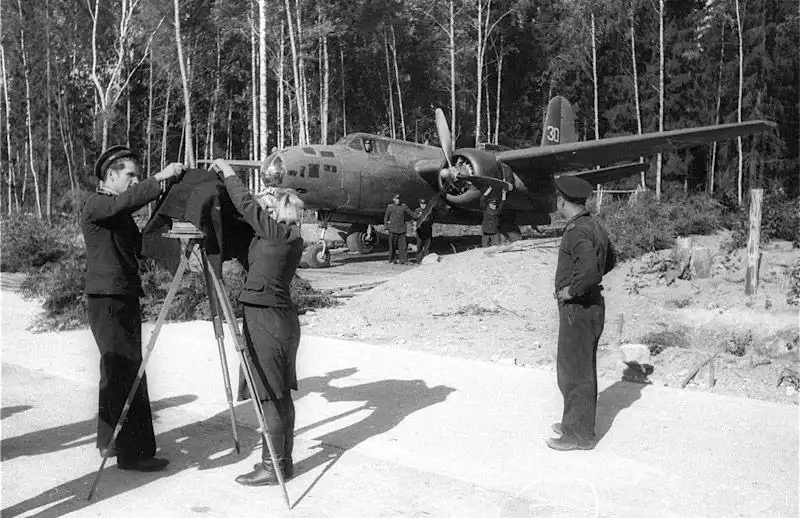
This remarkable World War II photograph shows an American-built Douglas A-20 “Boston” (board number 30) of the 1st Guards Mine-Torpedo Aviation Regiment of Soviet Naval Aviation. The aircraft belonged to the crew of Captain Alexander Mikhailovich Gagiev, who would later receive the title Hero of the Soviet Union for his combat achievements.
A Successful Torpedo Strike
The photograph was taken on September 19, 1944, only one day after Gagiev's crew carried out a successful torpedo attack that sank a 6,000-ton German transport ship in the Baltic Sea. Torpedo bombing was among the most dangerous forms of aerial warfare. To ensure accuracy, crews had to descend to very low altitude, maintain a steady approach, and release the torpedo while exposed to intense anti-aircraft fire from escort vessels and the target itself.
The A-20 Boston in Soviet Naval Aviation
Supplied under the Lend-Lease program, the Douglas A-20 became one of the Soviet Navy's most valuable strike aircraft. While the aircraft served primarily as a light bomber in American service, Soviet engineers and crews successfully adapted many A-20s for naval operations, equipping them to carry aerial torpedoes as well as conventional bombs. Its speed, reliability, and excellent low-altitude handling made it particularly effective over the Baltic and Black Seas.
The 1st Guards Mine-Torpedo Aviation Regiment
The 1st Guards Mine-Torpedo Aviation Regiment (1st GMTAP) was one of the Soviet Navy's elite aviation formations. Its crews specialized in attacking German shipping, laying naval mines, and disrupting enemy maritime supply routes. Every successful strike reduced the Kriegsmarine's ability to reinforce isolated garrisons and transport troops and equipment across the Baltic Sea during the final year of the war.
The Men Behind the Victory
Like many successful combat photographs, this image captures only the moment after the mission. Behind the relaxed appearance of the crew lay hours of careful planning, dangerous low-level flying, and the constant risk posed by German fighters and anti-aircraft defenses. Their successful attack was the result of experience, discipline, and precise teamwork rather than luck alone.
An American Aircraft Fighting for the Soviet Navy
The photograph also illustrates one of the lesser-known aspects of the Lend-Lease program. Thousands of American aircraft served not only with the Soviet Air Force but also with Soviet Naval Aviation. The A-20 Boston became one of the most successful foreign-built combat aircraft in Soviet service, earning an excellent reputation among naval aviators for its durability, versatility, and combat effectiveness.
Technical photo data:
📍 Location: Panevėžys Airfield, Lithuania, USSR
📅 Date: September 19, 1944
🛩 Aircraft: Douglas A-20 Boston, board No. 30
🧭 Unit: 1st Guards Mine-Torpedo Aviation Regiment (1st GMTAP)
📷 Author: Sergei Shimansky
Recommended literature:
- Yefim Gordon — Douglas A-20 Boston in Soviet Service
- Mikhail Morozov — Soviet Naval Aviation in World War II
- Richard Overy — The Air War: 1939–1945
- Edward J. Marolda — Naval Air Warfare in the Second World War
- David M. Glantz — When Titans Clashed