Lt. Thompson Highfill of the 99th Bombardment Group poses with Soviet pilots beside a Bell P-39 Airacobra at the Poltava airfield during Allied cooperation under Operation Frantic, summer 1944.
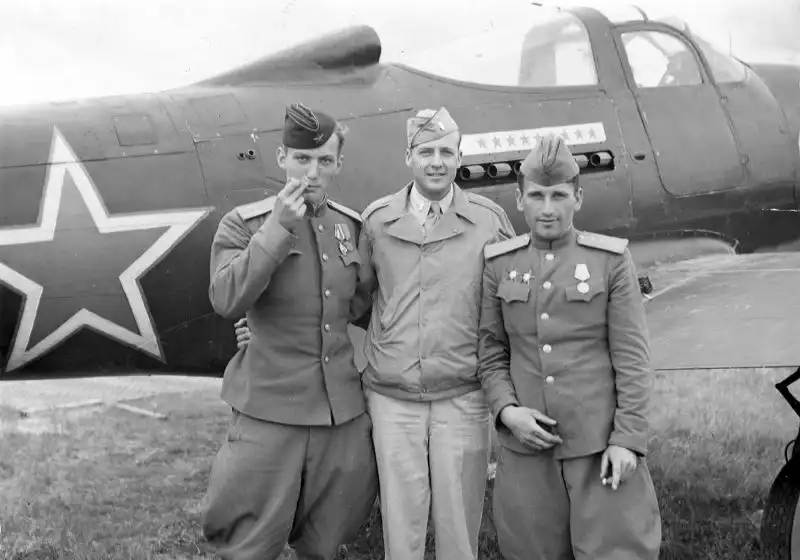
This remarkable World War II photograph captures Lt. Thompson Highfill of the 99th Bombardment Group, United States Army Air Forces, posing together with Soviet pilots beside a Bell P-39 Airacobra at the Poltava airfield in Soviet Ukraine during the summer of 1944. The image reflects one of the rare moments when American and Soviet airmen worked side by side against a common enemy, demonstrating the practical military cooperation between the Western Allies and the USSR.
Operation Frantic and the Poltava Airbases
The photograph was most likely taken during Operation Frantic, the series of American "shuttle bombing" missions launched in 1944. Heavy bombers of the USAAF attacked targets in German-occupied Europe, landed at Soviet airfields around Poltava to refuel and rearm, and then struck new objectives on their return flights. This arrangement allowed Allied aircraft to reach targets that were previously beyond their operational range while strengthening cooperation between the Soviet Union, the United States, and Great Britain.
Poltava became the principal American-operated base in the USSR, hosting hundreds of B-17 Flying Fortress bombers, P-51 Mustang escorts, transport aircraft, and technical personnel. Although the program achieved several successful missions, it also exposed the vulnerability of the airfields. On the night of 21–22 June 1944, the Luftwaffe launched a devastating raid on Poltava, destroying dozens of American bombers on the ground and severely disrupting the shuttle bombing campaign.
The Bell P-39 Airacobra in Soviet Service
While the Airacobra earned only mixed reviews from American and British pilots because of its poor high-altitude performance, it proved exceptionally effective on the Eastern Front. Most Soviet air combat took place below 5,000 meters, where the aircraft's excellent acceleration, powerful armament, and rugged construction became major advantages. Its devastating 37 mm M4 cannon, firing through the propeller hub, was capable of destroying both aircraft and lightly armored ground targets with a few well-placed hits.
The Soviet Union became the largest operator of the P-39, receiving nearly 5,000 Airacobras under the Lend-Lease program. Many of the Red Air Force's most celebrated fighter aces—including Aleksandr Pokryshkin, Grigory Rechkalov, and several other Guards pilots—achieved a significant portion of their victories while flying the Airacobra, giving the aircraft a legendary reputation in Soviet aviation history.
A Rare Meeting Between Allies
Photographs showing American and Soviet servicemen together remain relatively uncommon despite the alliance against Nazi Germany. This image documents not only the transfer of aircraft and equipment but also the personal encounters between pilots, mechanics, translators, and technicians who briefly shared the same airfields before post-war political divisions transformed former allies into Cold War rivals.
The photograph therefore preserves a unique moment when cooperation, rather than confrontation, united two of the world's largest air forces in pursuit of a common victory over the Third Reich.
Technical photo data
📍 Location: Poltava Airfield, Ukrainian SSR, Soviet Union
📅 Date: Summer 1944
📝 Event: Allied cooperation during Operation Frantic, USAAF personnel with Soviet pilots beside a Bell P-39 Airacobra
📷 Photographer: U.S. Army Air Forces / National Museum of the United States Air Force
Recommended reading
- John R. Bruning — Race of Aces
- Von Hardesty — Red Phoenix: The Rise of Soviet Air Power, 1941–1945
- Richard Overy — The Air War 1939–1945
- Boris Sokolov — Lend-Lease and Soviet Aviation
- Lend-Lease P-39 Airacobra USSR
- Soviet and American pilots WWII
- Operation Frantic Poltava Air Base
- Bell P-39 Airacobra Soviet aces
- Bell P-39 Lend-Lease deliveries
- Poltava airfield Operation Frantic