Soviet and American officers meet at the 169th Special Purpose Air Base (ABON) in Poltava, Ukraine, in June 1944, during Allied Lend-Lease cooperation and Operation Frantic.
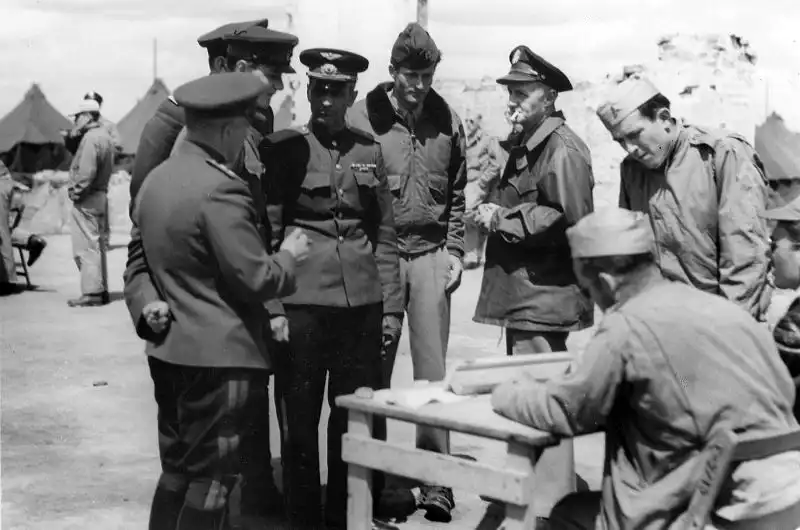
This remarkable World War II photograph captures a meeting between Soviet and American officers at the 169th Special Purpose Air Base (169th ABON) in Poltava, Ukraine, in June 1944. Standing from left to right are Major General A.R. Perminov, commander of the Soviet air base, Captain Henry Ware, serving as interpreter, and USAAF General Walsh. The image documents one of the closest moments of military cooperation between the Soviet Union and the United States during the war against Nazi Germany.
Operation Frantic and the Poltava Airfields
By 1944 the Western Allies sought to increase pressure on Germany by conducting long-range bombing missions that would not require aircraft to return immediately to Britain or Italy. This concept became known as Operation Frantic, a series of "shuttle bombing" missions in which American heavy bombers struck targets in German-controlled Europe before landing at Soviet airfields, refueling, rearming, and flying back on a different route.
To support these operations, the Soviet government assigned three major airfields in central Ukraine—Poltava, Mirgorod, and Piryatin. Soviet engineers expanded the facilities, strengthened runways, improved logistics, and organized anti-aircraft defenses to accommodate large numbers of American aircraft and personnel.
A Unique Allied Partnership
The officers shown in this photograph represent the extensive coordination required to make the operation possible. Translators bridged the language barrier, while Soviet and American commanders worked together on flight schedules, maintenance, fuel supplies, communications, weather forecasting, and airfield security. Cooperation extended well beyond diplomacy—it required daily coordination between hundreds of military specialists from two very different armed forces.
The Poltava bases also became an important meeting place where Soviet and American airmen exchanged technical experience, compared aircraft, and established personal relationships that would have been unimaginable only a few years earlier.
The German Air Raid on Poltava
The optimism surrounding Operation Frantic suffered a major setback on the night of 21–22 June 1944, when the Luftwaffe launched a devastating air raid against Poltava. Guided by reconnaissance aircraft and aided by insufficient night-fighter protection, German bombers destroyed or heavily damaged dozens of American B-17 Flying Fortress bombers and large quantities of fuel, ammunition, and equipment on the ground.
Although shuttle bombing missions continued after the attack, the destruction at Poltava exposed the vulnerability of even well-prepared rear airfields and limited the strategic impact of the program. Nevertheless, Operation Frantic remained one of the most remarkable examples of direct Soviet-American military cooperation during the Second World War.
This photograph preserves a rare moment when officers from two allied nations stood side by side, coordinating one of the most ambitious joint air operations of the war. It reflects not only military planning but also the temporary alliance that helped bring about the defeat of Nazi Germany.
Technical photo data
📍 Location: Poltava, Ukrainian SSR, Soviet Union
📅 Date: June 1944
📝 Event: Soviet and American officers at the 169th Special Purpose Air Base during Operation Frantic and Lend-Lease cooperation
📷 Photographer: US Air Force Museum
Recommended reading
- Roger A. Freeman — The Mighty Eighth War Diary
- James H. Howard — Black Thursday over Poltava
- David M. Glantz — When Titans Clashed: How the Red Army Stopped Hitler