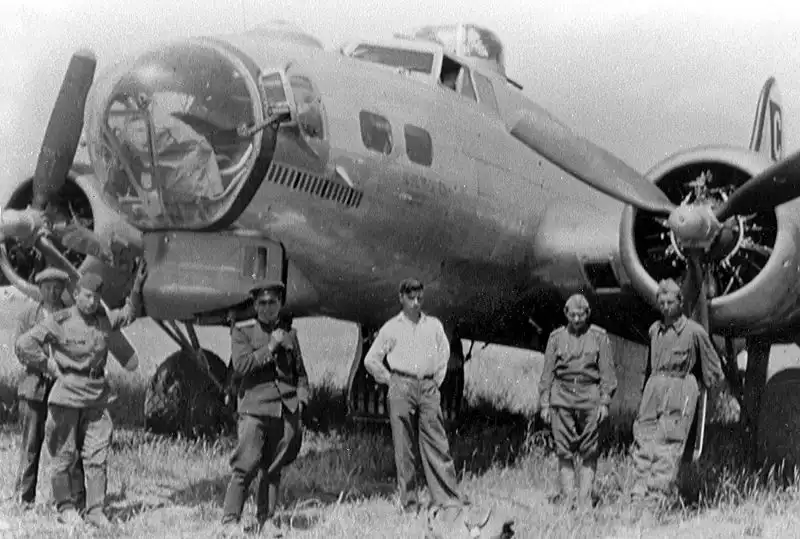
Heavily damaged B-17G Flying Fortress at Poltava Air Base after the German air raid of June 22, 1944, during the Allied shuttle bombing campaign.
The Night the Flying Fortresses Burned
This dramatic photograph shows a heavily damaged Boeing B-17G Flying Fortress resting on the airfield at Poltava after the devastating German Luftwaffe raid of 22 June 1944. The bomber had taken part in the Allied shuttle bombing campaign, an ambitious operation in which American heavy bombers attacked targets in German-occupied Europe before landing at Soviet airfields instead of returning directly to Britain or Italy.
Known as Operation Frantic, the shuttle missions represented one of the closest examples of operational cooperation between the United States and the Soviet Union during the Second World War. American aircraft used a network of bases centered on Poltava, Mirgorod, and Pyriatyn, where they were refueled, rearmed, and prepared for their next missions.
A Carefully Planned Attack
Although Soviet authorities had deployed anti-aircraft batteries and fighter units to defend the bases, German reconnaissance successfully located the concentration of Allied aircraft. On the night of 21–22 June 1944, the Luftwaffe launched a well-coordinated bombing raid that caught many bombers parked in the open.
The results were devastating. Contemporary reports record the destruction of 44 American aircraft and 15 Soviet aircraft, while many more were damaged beyond immediate repair. Fuel depots, ammunition stocks, and maintenance facilities also suffered heavy losses, making the Poltava raid one of the most successful long-range Luftwaffe operations against the Western Allies.
A Symbol of Allied Cooperation—and Its Risks
The B-17 Flying Fortress had become an icon of American strategic bombing, renowned for its durability, heavy defensive armament, and ability to absorb remarkable combat damage. Yet this photograph demonstrates that even such a resilient aircraft was vulnerable when caught on the ground.
The destruction at Poltava dealt a serious blow to Operation Frantic and exposed weaknesses in the security of the shuttle bases. Although the missions continued for a time, the scale of the losses and the logistical difficulties involved reduced their overall effectiveness. Today, this damaged Flying Fortress remains a powerful reminder of both the unprecedented cooperation between the Allies and the continuing ability of the Luftwaffe to strike unexpectedly, even far behind the front lines.
Technical Photo Data
Source: USAAF photographic archive (photographer unknown)
Location: Poltava Air Base, Ukrainian SSR, Soviet Union (present-day Ukraine)
Date: 22 June 1944
Aircraft: Boeing B-17G Flying Fortress (late-production model)
Recommended reading:
- Glenn B. Infield — Luftwaffe Night Over Poland and Russia
- James H. Doolittle & Carroll V. Glines — I Could Never Be So Lucky Again
- Steven J. Zaloga — Operation Frantic: The USAAF Shuttle Raids Against Germany