Soviet T-35 and T-26 tanks abandoned after the Battle of Dubno, July 1941 — a glimpse into one of the largest armored clashes of the Second World War.
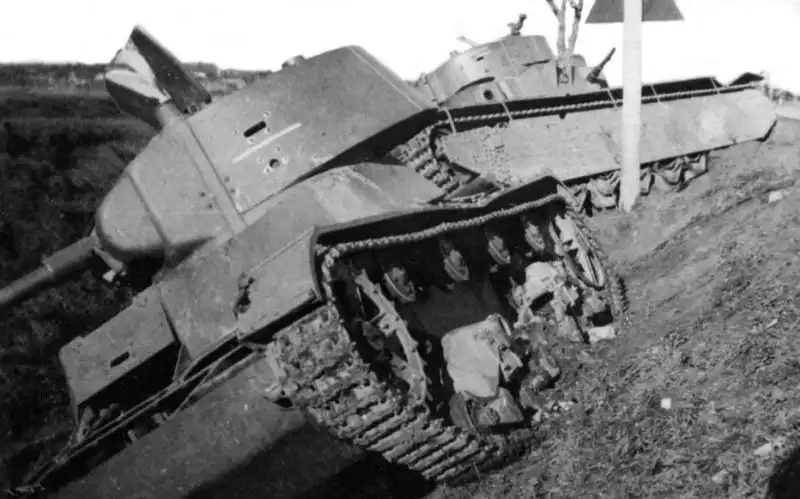
Abandoned Giants of the Dubno Battlefield
This remarkable wartime photograph captures two abandoned Soviet tanks following the fierce Battle of Dubno–Brody in the opening weeks of Operation Barbarossa. Resting in a roadside ditch is a massive T-35 heavy tank (Model 1938), with a T-26 light tank (Model 1939) standing in front of it. Both vehicles belonged to the 34th Tank Division of the 8th Mechanized Corps, one of the Red Army's largest armored formations committed to stopping the German advance through western Ukraine.
The white recognition stripes painted across the turrets identify these tanks as vehicles of the 67th Tank Regiment. On 22 June 1941 the division possessed an impressive but highly diverse inventory, including 7 KV heavy tanks, 38 T-35s, 238 T-26s, and 25 BT fast tanks. Within only a few weeks, however, relentless German attacks, mechanical failures, fuel shortages, and the chaotic conditions of the retreat reduced this powerful force to a shadow of its former strength.
The "Land Battleship" and Its Smaller Companion
The T-35 was one of the most unusual armored vehicles ever built. Nicknamed the "land battleship", it carried five separate turrets and required a crew of eleven men to operate effectively. Its imposing appearance made a strong impression, but in practice the tank proved mechanically fragile, difficult to maneuver, and poorly suited to the fast-moving battles of 1941.
Standing beside it is the much smaller T-26, a tank that had formed the backbone of Soviet armored forces during the 1930s. Reliable by pre-war standards and produced in large numbers, it nevertheless entered the German invasion already outclassed by modern anti-tank weapons and newer German armored vehicles. Together, the two machines illustrate both the diversity and the growing obsolescence of much of the Red Army's armored inventory at the outbreak of war.
A Survivor's Memory
The human cost of the Battle of Dubno is vividly reflected in the memoirs of Soviet tanker Vasily Vikentievich Sazonov, who fought in a T-35 during the campaign:
"I realized it was time to run. I crawled out of the turret and jumped onto the road. My loader followed, twisting his leg. I dragged him into a ditch, and our driver joined us. We crawled away just before our tank exploded after the Germans destroyed it. Later we linked up with the crew of a T-26 and continued retreating together. Only a handful of us survived. Of all the T-35 crews, just four men remained alive, each from a different tank. One vehicle hit a mine, another burned, another was blown apart... That was the end of the Battle of Dubno for me. I never again saw a T-35 in combat."
Sazonov's recollections provide a deeply personal perspective on one of the largest armored battles ever fought. They reveal not only the courage of Soviet tank crews but also the enormous challenges they faced—obsolete equipment, inadequate logistics, inexperienced command structures, and an enemy that had seized the initiative during the first weeks of the invasion. The abandoned T-35 and T-26 in this photograph stand today as silent witnesses to that desperate struggle.
Technical Photo Data
Source: Wehrmacht photographic archive (photographer unknown)
Location: Near Dubno, Ukrainian SSR, Soviet Union (present-day Ukraine)
Date: July 1941
Vehicles: T-35 heavy tank (Model 1938) and T-26 light tank (Model 1939)
Recommended reading:
- David M. Glantz — Barbarossa: Hitler's Invasion of Russia 1941
- Steven J. Zaloga — Soviet Tanks and Combat Vehicles of World War Two
- Mikhail Baryatinskiy — T-35 Heavy Tank and Other Multi-Turreted Tanks