Abandoned Soviet T-35 Heavy Tank in Grodek, 1941: A Rare Photo from the Early Eastern Front
December 21, 2025 - Reading time: 11 minutes
A rare 1941 photograph shows German soldiers inspecting an abandoned Soviet T-35 heavy tank in Grodek, Ukraine. One of the rarest multi-turret variants lost during the opening phase of Operation Barbarossa.
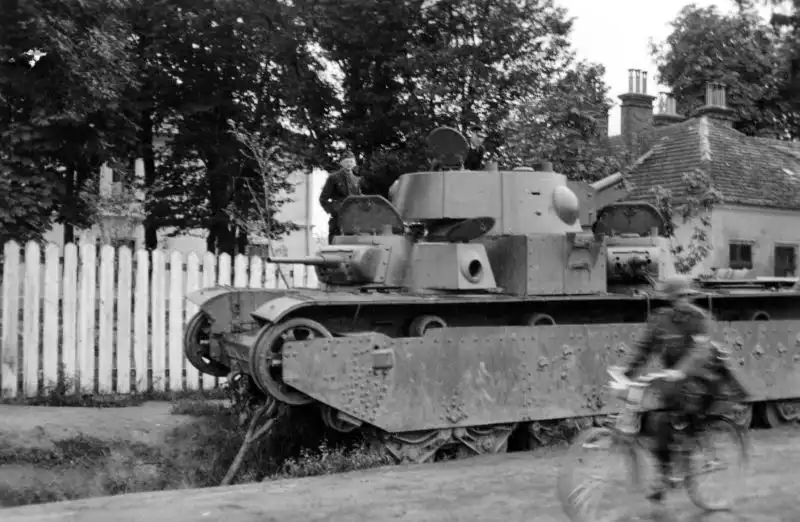
The Soviet T-35 heavy tank remains one of the most striking armored vehicles of World War II. This rare photograph, taken in 1941 in Grodek, shows a disabled T-35 abandoned during the chaotic early days of the German invasion of the Soviet Union.
The T-35: The Red Army’s Multi-Turret Giant
The T-35 was a unique heavy tank concept developed in the 1930s. Unlike later Soviet designs, it featured five turrets, intended to dominate the battlefield through overwhelming firepower.
Key characteristics of the T-35:
-
Main armament: 76.2 mm gun
-
Multiple secondary turrets with machine guns and cannons
-
Crew of up to 11 men
-
Designed primarily for breakthrough operations
Despite its impressive appearance, the T-35 suffered from mechanical unreliability, poor mobility, and high maintenance demands.
Tank Details: Serial Number 744-62
The tank shown in the photograph is a 1939 production T-35 with conical turrets and a straight turret ring base. Only seven tanks of this configuration were ever produced (serial numbers 744-61 to 744-67).
Important facts:
-
Serial number: 744-62
-
Only three T-35 tanks were built with a straight turret ring base
-
Unit: 67th Tank Regiment, 34th Tank Division
-
Formation: 8th Mechanized Corps, Southwestern Front
This makes the photographed vehicle one of the rarest variants of the entire T-35 production run.
Location and Circumstances of Abandonment:
The tank was abandoned on Lvivska Street in the town of Grodek, in what was then the Ukrainian SSR of the Soviet Union. This road section formed part of the Przemyśl–Lviv highway, a key route during the opening phase of Operation Barbarossa.
According to eyewitness accounts:
-
The tank suffered damage to its track assemblies
-
A side clutch was burned out
-
All ammunition had been expended
-
The vehicle was deliberately disabled
-
Weapons were removed by the crew
The commander of the tank was Taranenko.
German Inspection and Aftermath:
German soldiers are seen inspecting the abandoned tank shortly after its capture. Later, the T-35 was:
-
Towed slightly off the road
-
Stripped of its tracks
-
Marked with warning signs for passing vehicles
The tank was left near a military checkpoint on the southern side of the street. Interestingly, locals reported that a military facility remained at this location even after the war.
Why the T-35 Failed in Combat:
The fate of this tank reflects the broader operational problems of the T-35 during 1941:
-
Frequent mechanical breakdowns
-
Difficulty maneuvering on narrow roads
-
Poor logistical support during rapid retreats
-
Vulnerability despite heavy armor
Most T-35 tanks were lost without direct enemy fire, abandoned by their crews during the retreat.
Historical Significance of the Photograph:
Photographs like this provide invaluable insight into:
-
Early Eastern Front combat conditions
-
Soviet armored doctrine before 1941
-
The transition from multi-turret designs to more practical tanks like the T-34
For historians and military enthusiasts, this image captures the end of an era in tank design.
Photo Information:
-
📝 Source: wartime German photograph
-
📍 Location: Grodek, Ukrainian SSR, USSR
-
📅 Date: 1941
-
📷 Author: unknown
Conclusion:
The abandoned T-35 in Grodek stands as a symbol of early-war chaos and flawed prewar concepts. While visually imposing, the T-35 proved unsuited to the fast-paced armored warfare of World War II, leaving behind images like this as silent witnesses to history.
👉 See also: other rare photos of Soviet armored vehicles during Operation Barbarossa.
Related Pages
Category
Search
Categories
- Unidentified WWII Photos (14)
- World War II Photos 1937 (1)
- World War II Photos 1938 (1)
- World War II Photos 1939 (3)
- World War II Photos 1940 (5)
- World War II Photos 1941 (103)
- World War II Photos 1942 (60)
- World War II Photos 1943 (56)
- World War II Photos 1944 (77)
- World War II Photos 1945 (50)
- WWII and Postwar Photos 1946 (1)