Dornier Do.335 Pfeil – Germany’s Fastest Piston Aircraft of World War II
December 31, 2025 - Reading time: 11 minutes
The Dornier Do.335 Pfeil was Germany’s fastest piston aircraft of World War II, featuring a unique push-pull engine design and unmatched speed.
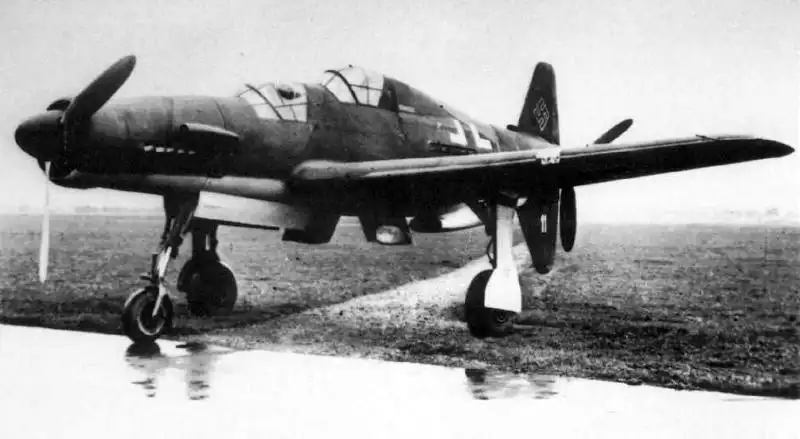
The Dornier Do.335 Pfeil was one of the most unusual and advanced aircraft of World War II. Designed in Germany in 1943, it featured a rare tandem engine configuration and became the fastest piston-engined aircraft of its era, reaching speeds unmatched by any operational propeller-driven fighter.
An Unconventional Design: Push–Pull Configuration:
What made the Do.335 truly unique was its inline push–pull engine layout:
-
One engine driving a tractor propeller in the nose
-
A second engine driving a pusher propeller at the rear of the fuselage
This configuration eliminated asymmetric thrust typical of twin-engine aircraft and dramatically reduced aerodynamic drag, allowing the aircraft to combine:
-
Twin-engine power
-
Single-engine handling characteristics
The result was exceptional straight-line speed and stability.
Performance That Redefined Limits:
The Dornier Do.335 was an engineering breakthrough in terms of performance:
-
Maximum speed: up to 785 km/h
-
Role: heavy fighter / fighter-bomber
-
Powerplant: two Daimler-Benz inline piston engines
-
Climb rate and acceleration: superior to most Allied fighters
No other piston-powered combat aircraft of World War II could match its top speed.
Intended Role: The Ultimate Fighter-Bomber:
The Do.335 was designed as a multi-role aircraft, capable of:
-
Intercepting bombers
-
Escorting missions
-
High-speed strike and fighter-bomber operations
Had it entered mass production, the Pfeil would have been the fastest fighter-bomber in the world, capable of outrunning most enemy fighters rather than engaging them.
Technical Challenges and Delayed Production:
Despite its promise, the Do.335 suffered from serious issues:
-
Complex mechanical systems
-
Difficult maintenance
-
Emergency escape challenges due to rear propeller
-
Late introduction during the war
Although engineers implemented solutions such as ejector seats and explosive bolts to jettison the rear propeller, these innovations came too late to change the course of the program.
Why the Do.335 Never Changed the War:
Several factors prevented the Dornier Do.335 from having real strategic impact:
-
Germany’s collapsing industrial capacity
-
Allied bombing campaigns
-
Fuel shortages
-
Limited pilot training time
Only a small number of aircraft were completed, and the Do.335 never reached full combat deployment.
Historical Significance:
Today, the Dornier Do.335 Pfeil is remembered as:
-
The fastest piston aircraft of World War II
-
One of the most advanced German aircraft designs
-
A technological dead end caused by timing rather than concept
Its design foreshadowed postwar high-speed aircraft development.
Photo Information:
-
📝 Source: wartime German aviation photograph
-
📍 Location: Germany
-
📅 Date: 1943
-
✈ Aircraft: Dornier Do.335 A-12 Pfeil
The Dornier Do.335 remains one of the greatest “what-if” aircraft of World War II. Technically brilliant yet strategically irrelevant, it demonstrated how close piston-engine aviation came to its absolute limits before the jet age rendered such designs obsolete.
👉 See also: German experimental aircraft of WWII and late-war Luftwaffe fighter projects.
Related Pages

Tags
Category
Search
Categories
- Unidentified WWII Photos (14)
- World War II Photos 1937 (1)
- World War II Photos 1938 (1)
- World War II Photos 1939 (3)
- World War II Photos 1940 (5)
- World War II Photos 1941 (103)
- World War II Photos 1942 (60)
- World War II Photos 1943 (54)
- World War II Photos 1944 (77)
- World War II Photos 1945 (42)
- WWII and Postwar Photos 1946 (1)