A rare wartime aerial photograph of a German Heinkel He 111 bomber in flight, taken from another Luftwaffe aircraft. The image offers an unusual view of one of Germany’s best-known medium bombers while also revealing part of the defensive armament carried by its escorting crew.
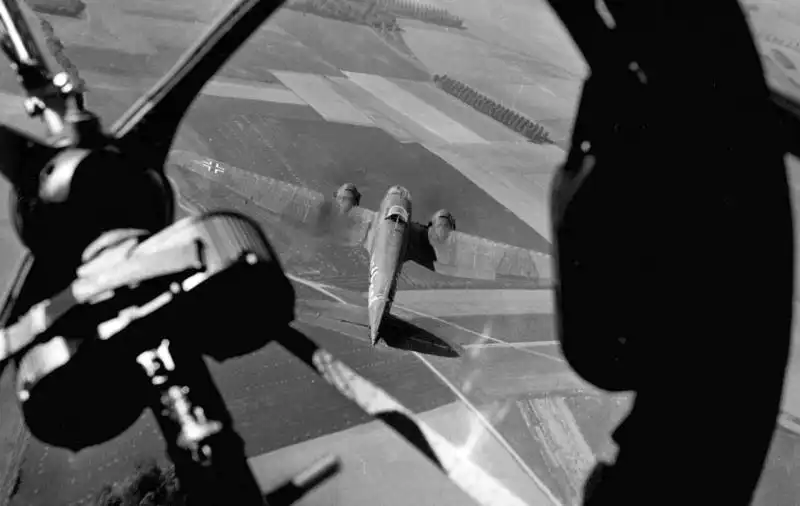
Alt text: German Heinkel He 111 bomber photographed in flight from another Luftwaffe aircraft with an MG 15 machine gun visible in the foreground.
German Heinkel He 111 Bomber Photographed in Flight
This remarkable wartime photograph captures a Heinkel He 111 from the perspective of another German aircraft flying in formation. Unlike the majority of surviving Luftwaffe photographs taken on airfields, this image places the viewer in the air alongside the bomber crew. Even more interesting, the left edge of the frame includes part of an MG 15 machine gun, reminding us that every flight over wartime Europe carried the constant possibility of enemy interception.
The Luftwaffe's Most Recognizable Bomber
The Heinkel He 111 became one of the defining aircraft of the German Air Force during the Second World War. Originally developed in the 1930s, it was officially presented as a civilian transport aircraft before openly entering military service as a medium bomber.
By the outbreak of war, the aircraft formed the backbone of many Luftwaffe bomber wings. It participated in campaigns across Europe and remained in service long after more modern designs had begun to appear.
- Twin-engine medium bomber
- Typical crew of five men
- Large internal bomb bay
- Good operational range for strategic missions
- Produced in thousands throughout the war
A Veteran of Every Major Campaign
Few German aircraft appeared over so many battlefields. The He 111 took part in the invasions of Poland, Norway, France, the Balkans and the Soviet Union. It also became one of the principal bombers employed during the Battle of Britain.
As the war progressed, however, Allied fighter aircraft became faster and better armed. Missions that had once been flown with relative confidence increasingly resulted in heavy losses. Despite these growing difficulties, the He 111 continued serving because Germany lacked sufficient numbers of more advanced bombers to replace it completely.
An Unusual View from Inside the Formation
The greatest historical value of this photograph lies in its perspective. Wartime aviation photography was technically difficult, and relatively few images survive that were taken from one aircraft while another flew nearby.
The photograph shows several details that would have been familiar to Luftwaffe crews:
- The bomber maintaining close formation with another aircraft.
- The upper fuselage and glazed cockpit characteristic of the Heinkel He 111.
- An MG 15 defensive machine gun visible in the foreground, belonging to the aircraft from which the photograph was taken.
Rather than depicting combat itself, the image illustrates the routine moments that filled most wartime flying. Bomber crews spent countless hours navigating toward distant objectives while remaining alert for hostile fighters that could appear with little warning.
The MG 15 Defensive Machine Gun
The weapon visible in the foreground is the 7.92 mm MG 15, one of the Luftwaffe's standard flexible defensive machine guns during the early years of the war. Mounted on movable positions, it allowed air gunners to engage attacking fighters from different angles.
Although advanced when introduced, the MG 15 eventually proved less effective against increasingly well-protected Allied aircraft. Its drum-fed ammunition required frequent magazine changes during combat, prompting the Luftwaffe to introduce heavier and more practical defensive weapons later in the war.
More Than Just an Aircraft Portrait
At first glance, this appears to be a simple photograph of a bomber in flight. In reality, it captures the working environment of an aircrew operating thousands of meters above the ground. Every member of the crew had a specific responsibility, from navigation and radio communication to maintaining lookout for enemy fighters.
Images like this help historians understand the everyday reality of aerial warfare beyond dramatic combat scenes. Long flights, tight formation discipline and constant vigilance were routine parts of a bomber crew's life, even when no enemy aircraft were visible.
Historical Significance
This photograph is valuable because it documents several aspects of Luftwaffe operations at once:
- Formation flying during wartime missions.
- The appearance of the Heinkel He 111 in operational service.
- Defensive equipment carried by German bomber crews.
- A rare airborne perspective seldom preserved in wartime photography.
For aviation historians, such photographs provide context that technical manuals cannot. They show aircraft as they actually appeared during active service rather than in carefully staged publicity images.
Photo Information
- Source: Wartime German photograph
- Location: Europe (exact location unknown)
- Date: World War II
- Photographer: Luftwaffe aircrew member
Conclusion
This rare in-flight photograph preserves a moment from the daily routine of the Luftwaffe bomber force. The Heinkel He 111 appears not as a museum exhibit or propaganda symbol, but as an operational aircraft carrying out another mission somewhere over wartime Europe. Combined with the visible MG 15 machine gun in the foreground, the image offers an unusually authentic glimpse into the working environment of German bomber crews during the Second World War.
Recommended reading:
- William Green — Warplanes of the Third Reich
- Manfred Griehl — Heinkel He 111
- Richard Overy — The Air War: 1939–1945