Messerschmitt Me.323 “Gigant” – The World’s First Military Heavy Transport Aircraft
December 31, 2025 - Reading time: 12 minutes
The Messerschmitt Me.323 Gigant was the world’s first heavy military transport aircraft, capable of carrying trucks, artillery, and massive cargo loads.
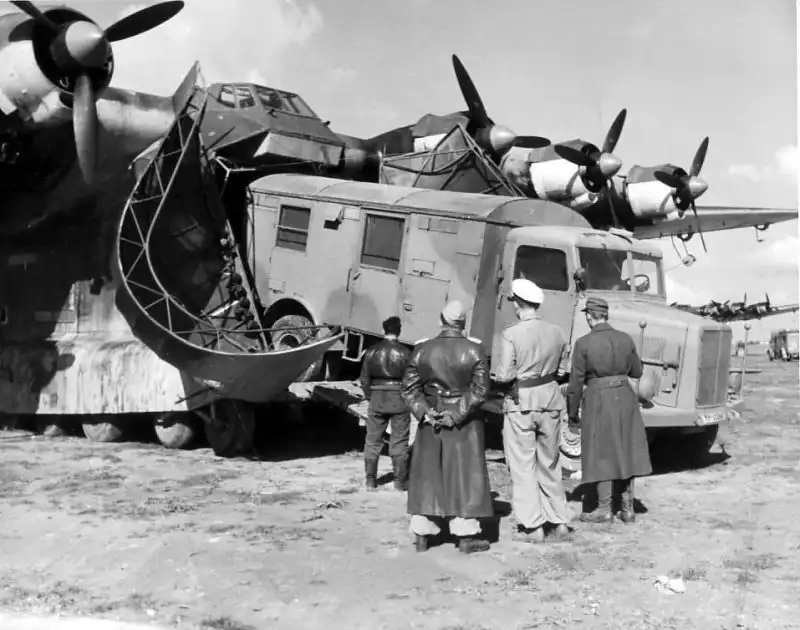
The Messerschmitt Me.323 “Gigant” was the largest land-based transport aircraft to enter operational service during World War II. Developed by Nazi Germany, it became the world’s first purpose-built heavy military transport aircraft, capable of carrying vehicles, artillery, and massive cargo loads directly to frontline airfields.
From Glider to Giant Transport:
The Me.323 originated from the Me.321 glider, which was initially designed to transport heavy equipment. However, the vulnerability and limitations of tow operations led to the creation of a powered version.
Key design features included:
-
A very wide fuselage
-
A large front-opening cargo door
-
A transformable cargo bay
-
Multi-wheel landing gear for rough airfields
These innovations later became standard for military transport aviation worldwide.
Unmatched Cargo Capability:
One of the Me.323’s defining strengths was its payload:
-
Maximum cargo: over 10–12 tons
-
Capable of transporting:
-
Trucks (like the MAN L4500S, ~8 tons)
-
Light tanks
-
Artillery pieces
-
Ammunition and fuel
-
The aircraft could unload cargo directly forward, dramatically speeding up ground operations.
Operational Use in WWII:
The Me.323 was used in several theaters:
-
North Africa — supplying Rommel’s Afrika Korps
-
Italy — logistical support during Allied landings
-
Eastern Front — late 1943 to early 1944 flights to Odessa and Sevastopol
Despite its utility, the aircraft often operated in extremely dangerous conditions.
A Huge Target in a Hostile Sky:
The Gigant’s weaknesses were brutal:
-
Very slow speed
-
Poor defensive armament
-
Massive silhouette
-
Extremely vulnerable to fighters
Allied aircraft slaughtered Me.323 formations, especially over the Mediterranean. Entire transport groups were wiped out in single engagements.
Strengths That Still Mattered:
Even with its flaws, the Me.323 had real advantages:
-
High fuel efficiency for its size
-
Excellent field repairability
-
Ability to operate from primitive airstrips
-
Strategic lift capacity unmatched at the time
In pure logistics terms, it was ahead of its era.
Historical Significance:
The Messerschmitt Me.323 is historically important because it was:
-
The first true military heavy transport aircraft
-
A direct ancestor of modern cargo aircraft concepts
-
Proof that air logistics could decide campaigns
It failed tactically, but succeeded technologically.
Photo Information:
-
📝 Subject: unloading MAN L4500S truck
-
📍 Location: Tunisia
-
📅 Date: late 1942
-
✈ Aircraft: Messerschmitt Me.323 “Gigant”
The Me.323 “Gigant” was slow, vulnerable, and often doomed — but it changed military aviation forever. It proved that logistics could fly, and that idea outlived the Third Reich by decades.
👉 Related: German transport aircraft of WWII • Luftwaffe logistics in North Africa • Experimental military aviation
Related Pages


Tags
Category
Search
Categories
- Unidentified WWII Photos (14)
- World War II Photos 1937 (1)
- World War II Photos 1938 (1)
- World War II Photos 1939 (3)
- World War II Photos 1940 (5)
- World War II Photos 1941 (103)
- World War II Photos 1942 (60)
- World War II Photos 1943 (54)
- World War II Photos 1944 (77)
- World War II Photos 1945 (42)
- WWII and Postwar Photos 1946 (1)