B-17 Flying Fortress Bombing the Focke-Wulf Aircraft Factory, 1943
January 3, 2026 - Reading time: 13 minutes
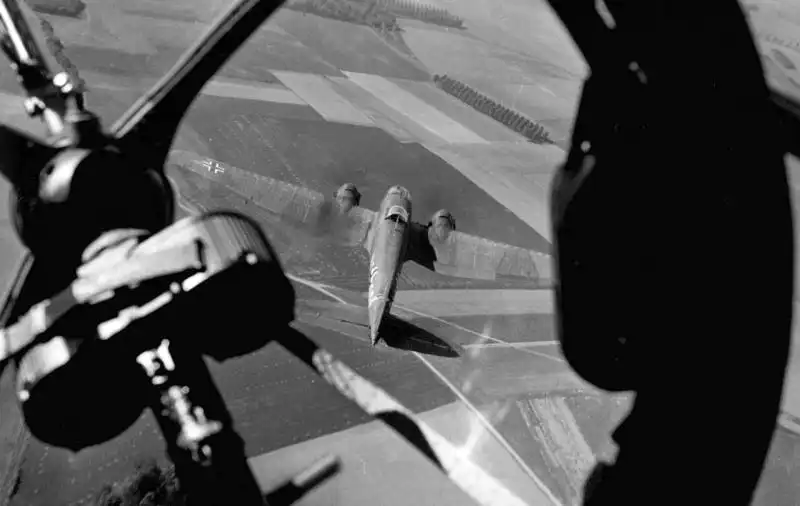
A B-17 Flying Fortress releases bombs over the Focke-Wulf factory during the first major U.S. daylight raid deep into Germany.
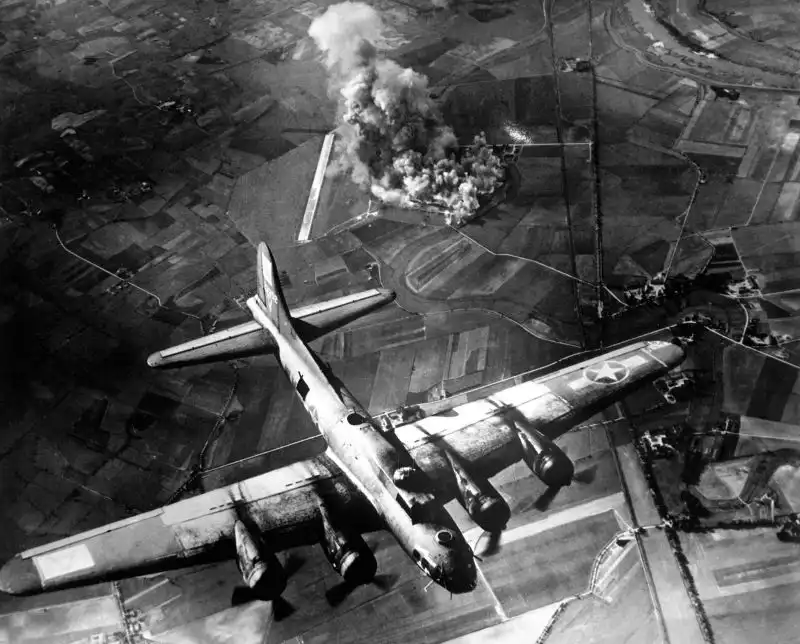
On October 9, 1943, B-17 Flying Fortress bombers of the 303rd Bombardment Group (USAAF) carried out one of the most daring missions of the air war over Europe — a deep strategic bombing raid on the Focke-Wulf aircraft factory in Marienburg, Germany.
It was the first major American daylight bombing attack deep inside German territory, marking a turning point in the Allied air offensive against the Third Reich.
The Target: Focke-Wulf Aircraft Works:
The factory at Marienburg (today Malbork, Poland) was a key production center for Focke-Wulf aircraft, including fighters used by the Luftwaffe on multiple fronts.
Destroying this facility meant:
-
Disrupting German aircraft production
-
Weakening Luftwaffe fighter strength
-
Forcing Germany to divert resources to air defense
The target was heavily defended and far beyond the range of continuous Allied fighter escort.
The B-17 Flying Fortress:
The B-17 was the backbone of the U.S. strategic bombing campaign:
-
Four-engine heavy bomber
-
Heavy defensive armament
-
High-altitude precision bombing doctrine
Despite its nickname, the Flying Fortress was not invulnerable, especially when operating without long-range fighter cover.
The Mission and the Bombing Run:
During the attack:
-
B-17s dropped heavy high-explosive bombs on the factory complex
-
Bombs were released from high altitude under intense anti-aircraft fire
-
The bombing caused significant damage to production facilities
The photograph captures the exact moment when bombs fall from the aircraft — a visual record of industrial warfare from the air.
German Fighter Interception:
On the return flight, the bomber formations were:
-
Intercepted by Luftwaffe fighters
-
Attacked repeatedly without escort protection
-
Forced into defensive box formations
American losses were severe:
-
Approximately 80 bombers were lost
-
Hundreds of aircrew were killed or captured
The mission demonstrated both the reach and the cost of daylight strategic bombing.
Strategic Importance of the Raid:
Despite heavy losses, the Marienburg raid proved that:
-
The USAAF could strike deep inside Germany
-
German industrial centers were vulnerable
-
Strategic bombing would become a central tool of Allied victory
Lessons learned from this mission accelerated the deployment of long-range escort fighters, such as the P-51 Mustang.
The Human Cost of Strategic Bombing:
Behind the statistics were:
-
Young bomber crews flying into extreme danger
-
Civilians working in industrial zones
-
Entire cities exposed to total war from the air
Strategic bombing blurred the line between battlefield and home front.
Historical Significance:
This raid stands as:
-
A milestone in the Allied air campaign
-
A demonstration of both courage and sacrifice
-
A reminder of the brutal economics of industrial warfare
It was not just an attack on a factory — it was an attack on Germany’s ability to continue the war.
Photo Information:
-
📝 Subject: B-17 bombing Focke-Wulf aircraft factory
-
📍 Location: Marienburg, Germany
-
📅 Date: October 9, 1943
-
✈ Unit: 303rd Bombardment Group, USAAF
The bombing of the Focke-Wulf factory at Marienburg marked the moment when the air war over Europe entered a new phase. It showed that strategic bombing could reach the heart of Germany — but only at an enormous human cost.
👉 Related: USAAF strategic bombing • B-17 Flying Fortress history • Air war over Europe
Related Pages

Category
Search
Categories
- Unidentified WWII Photos (14)
- World War II Photos 1937 (1)
- World War II Photos 1938 (1)
- World War II Photos 1939 (3)
- World War II Photos 1940 (5)
- World War II Photos 1941 (103)
- World War II Photos 1942 (60)
- World War II Photos 1943 (56)
- World War II Photos 1944 (77)
- World War II Photos 1945 (44)
- WWII and Postwar Photos 1946 (1)