Soviet Lieutenant Vorozheev and USAAF Staff Sergeant Thomas Summers stand beside the tail gun position of a B-17 Flying Fortress at Poltava Airfield during Operation Frantic, June 1944.
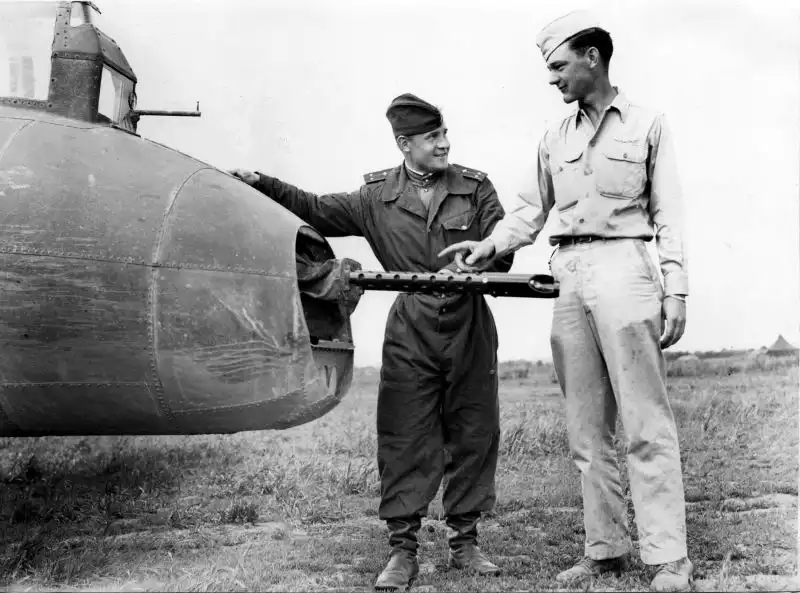
This World War II photograph shows Soviet Lieutenant Vorozheev and USAAF Staff Sergeant Thomas Summers standing beside the tail gun position of a B-17 Flying Fortress at Poltava Airfield in June 1944. Taken during Operation Frantic, the image reflects the close cooperation between Soviet and American personnel who worked together to support Allied air operations from Soviet territory.
The Tail Gunner's Position
The rear of the B-17 was one of the bomber's most vulnerable areas during combat. Enemy fighters often attacked from behind, making the tail gunner the aircraft's last line of defense. Seated in a cramped compartment at the very end of the fuselage, the gunner operated two .50-caliber Browning machine guns while maintaining constant vigilance throughout long combat missions.
Tail gunners faced some of the highest casualty rates among bomber crews. They worked in freezing temperatures at high altitude, endured constant vibration and noise, and were frequently the first to engage attacking fighters approaching from the rear.
Operation Frantic
The photograph was taken at the 169th Special Purpose Air Base during Operation Frantic, the Allied shuttle bombing campaign of 1944. Under this program, American heavy bombers flew missions over German-occupied Europe before landing at Soviet airfields to refuel, rearm, and undergo maintenance. Poltava, together with Mirgorod and Piryatin, became one of the principal bases supporting these operations.
Although American crews flew the aircraft, Soviet personnel played an essential role by providing security, air defense, logistics, engineering support, and airfield operations. The success of the shuttle missions depended upon the combined efforts of thousands of servicemen from both nations.
A Symbol of Allied Cooperation
Rather than depicting combat, this photograph captures an informal meeting between two Allied servicemen beside one of the most recognizable defensive positions of the Second World War. It illustrates how Operation Frantic created opportunities for Soviet and American military personnel to exchange experience, inspect each other's equipment, and work toward the common objective of defeating Nazi Germany.
Technical photo data
📍 Location: Poltava Airfield, Ukrainian SSR, Soviet Union
📅 Date: June 1944
📝 Event: Soviet and American servicemen beside a B-17 Flying Fortress during Operation Frantic
📷 Photographer: US Air Force Museum
Recommended reading
- Roger A. Freeman — The Mighty Eighth
- Martin Bowman — B-17 Flying Fortress Units of the Eighth Air Force
- David M. Glantz — When Titans Clashed: How the Red Army Stopped Hitler
Related photos
- US and Soviet technicians servicing a B-17
- American and Soviet airmen at Poltava
- Everyday life at the Poltava Air Hub
- Damaged B-17 Flying Fortress at Poltava
- B-17 Flying Fortress tail gun position