USAAF and Soviet technicians perform maintenance on the engine of a B-17 Flying Fortress at Poltava Airfield during Operation Frantic, Ukraine, June 1944.
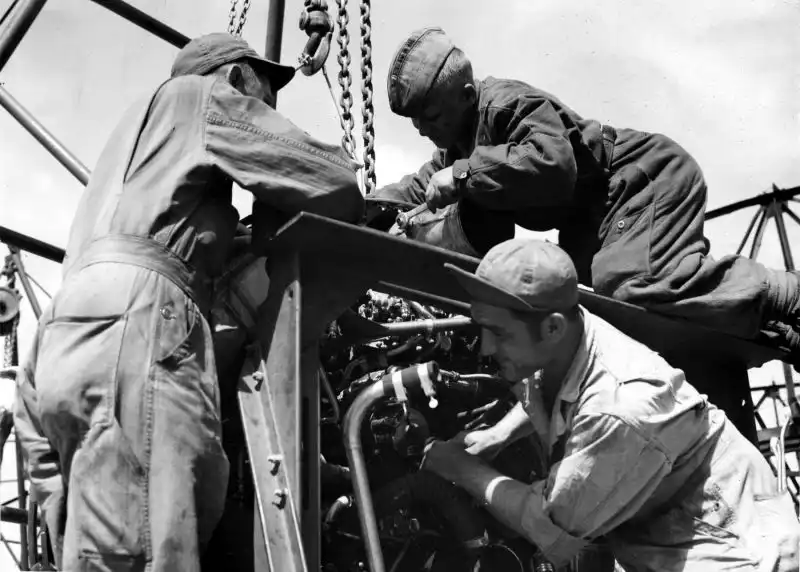
This World War II photograph captures a rare moment of Allied cooperation as USAAF Sergeants John M. Bassett and Michael Cajolda work together with Soviet aviation technician Leonid Boykov while servicing the engine of a B-17 Flying Fortress at Poltava Airfield in June 1944. The scene was photographed during Operation Frantic, the unique shuttle bombing campaign that brought American heavy bombers to Soviet air bases.
The Legendary B-17 Flying Fortress
The Boeing B-17 Flying Fortress became one of the most famous bombers of the Second World War. Designed for long-range strategic bombing, it carried large bomb loads deep into German-controlled Europe while relying on its rugged construction and heavy defensive armament for survival. Its nickname, "Flying Fortress," reflected the numerous machine-gun positions that gave the aircraft formidable defensive firepower against enemy fighters.
Although the Soviet Union received many American aircraft through Lend-Lease, the B-17 itself was never supplied in significant numbers. As a result, American crews and Soviet ground personnel had a valuable opportunity to exchange technical knowledge while operating together at Poltava.
Operation Frantic
Operation Frantic was one of the most ambitious examples of Allied cooperation during the war. Instead of returning to Britain or Italy after bombing missions, American bombers landed at Soviet airfields, where they were refueled, rearmed, repaired, and prepared for their next mission. The principal bases for these operations were located at Poltava, Mirgorod, and Piryatin in Ukraine.
Keeping dozens of four-engine bombers operational required close cooperation between American mechanics and Soviet specialists. While USAAF crews possessed detailed knowledge of the B-17's systems, Soviet technicians contributed valuable experience operating large military airfields under demanding wartime conditions. The partnership shown in this photograph reflects a practical alliance built on professionalism and a shared objective rather than political ideology.
A Rare Moment of Cooperation
Photographs like this are uncommon because they capture everyday cooperation instead of combat. American and Soviet servicemen worked side by side despite language barriers, different equipment, and different maintenance procedures. Their combined efforts kept Operation Frantic functioning during one of the few periods when the Western Allies and the Soviet Union conducted large-scale joint air operations from the same bases.
Technical photo data
📍 Location: Poltava Airfield, Ukrainian SSR, Soviet Union
📅 Date: June 1944
📝 Event: Joint maintenance of a USAAF B-17 Flying Fortress during Operation Frantic
📷 Photographer: US Air Force Museum
Recommended reading
- Roger A. Freeman — The Mighty Eighth
- Steven J. Zaloga — B-17 Flying Fortress Units of the Eighth Air Force
- David M. Glantz — When Titans Clashed: How the Red Army Stopped Hitler
Related photos
- Damaged B-17 at Poltava Air Base
- Repairing a B-17 Flying Fortress at Poltava
- American and Soviet airmen together
- Operation Frantic command personnel
- Operation Frantic maintenance crews