USAAF Colonels Barton and Rice pose with a Soviet female interpreter at the 169th Special Purpose Air Base during Operation Frantic, Poltava, Ukraine, June 1944.
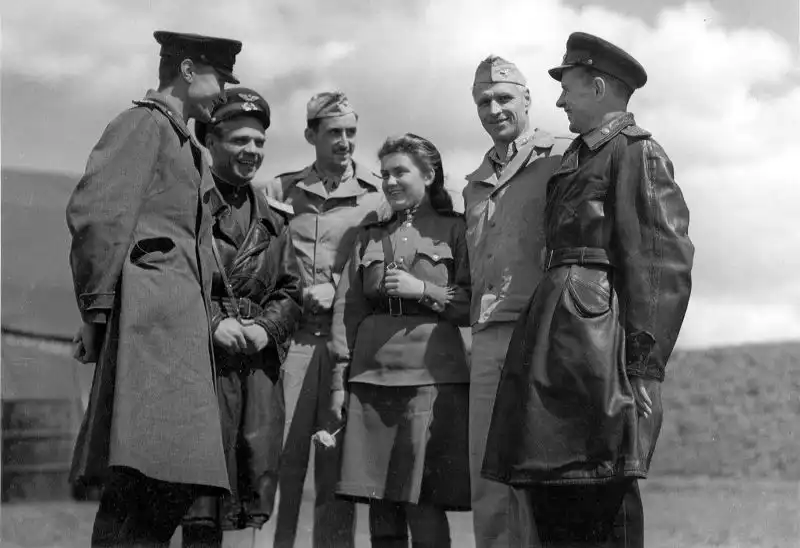
This World War II photograph shows Colonel Barton of the USAAF 483rd Bombardment Group, Colonel Rice of the 2nd Bombardment Group, and a Soviet female interpreter at the 169th Special Purpose Air Base in Poltava during Operation Frantic in June 1944. The interpreter is holding a wildflower reportedly presented to her by one of the American officers, adding an unexpectedly personal touch to an otherwise official military photograph.
The People Who Made Cooperation Possible
While bomber crews and fighter pilots received most of the attention, successful cooperation between the Western Allies and the Soviet Union depended just as much on hundreds of officers, administrators, engineers, and translators. Every briefing, maintenance discussion, logistics meeting, and operational order required accurate communication between personnel who spoke different languages and followed different military procedures.
Military interpreters occupied a unique position. They needed more than language skills—they also had to understand aviation terminology, military ranks, technical equipment, and operational planning. A single mistranslation could lead to delays, confusion, or even accidents during flight operations.
Operation Frantic Headquarters
Poltava became the principal Soviet base supporting Operation Frantic, the Allied shuttle bombing campaign of 1944. American heavy bombers landed there after attacking targets across occupied Europe before continuing to other Allied bases. Coordinating these complex missions required continuous communication between Soviet commanders and USAAF officers responsible for flight operations, maintenance, logistics, security, and airfield management.
Senior officers such as Colonels Barton and Rice spent much of their time planning missions, inspecting facilities, and coordinating with their Soviet counterparts. Although combat crews flew the aircraft, the success of every operation depended upon careful organization behind the scenes.
A Rare Human Moment
Unlike many wartime photographs that focus on aircraft or combat, this image captures the people responsible for cooperation itself. The field flower held by the interpreter adds a surprisingly informal element, reminding viewers that even during a global war, brief moments of kindness and friendship could emerge between allies from very different countries and cultures.
Technical photo data
📍 Location: Poltava Airfield, Ukrainian SSR, Soviet Union
📅 Date: June 1944
📝 Event: USAAF commanders and Soviet interpreter during Operation Frantic
📷 Photographer: US Air Force Museum
Recommended reading
- Roger A. Freeman — The Mighty Eighth
- David M. Glantz — When Titans Clashed: How the Red Army Stopped Hitler
- Richard Overy — Why the Allies Won
Related photos
- US and Soviet officers beside a B-17 Flying Fortress
- Command staff at the Poltava Air Hub
- Joint maintenance of a B-17 bomber
- American and Soviet airmen at Poltava
- Military interpreters during World War II