American Sherman tank crew poses beside the destroyed German PzKpfw IV in Western Europe, 1944.
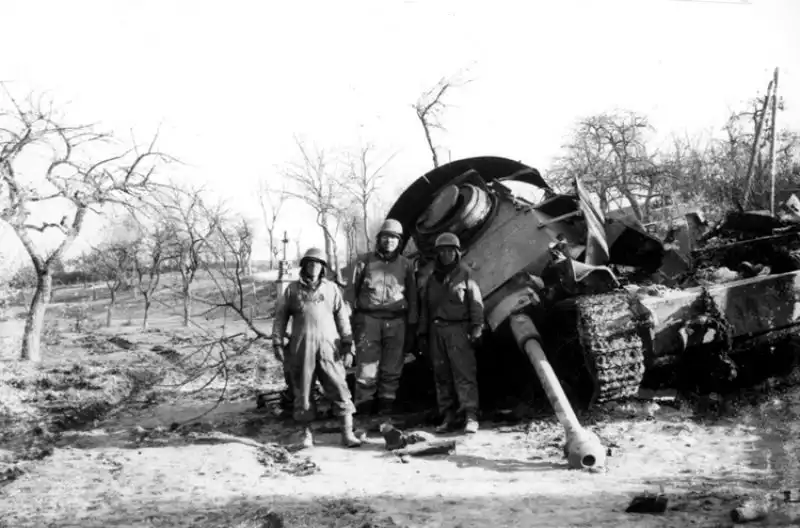
American tankers pose beside the burned-out wreck of a German Panzer IV after a successful engagement during the Allied campaign in Western Europe in 1944. The destroyed vehicle, its turret torn apart by an internal ammunition explosion, demonstrates the devastating consequences of armor penetration during the final year of the Second World War.
The Sherman and the Battle for Western Europe
The M4 Sherman became the principal medium tank of the United States Army and its Allies. More than 49,000 Shermans of all variants were built during the war, making it one of the most widely produced tanks of the conflict. Although its armor and gun were often inferior to those of late-war German heavy tanks, the Sherman earned an outstanding reputation for mechanical reliability, ease of maintenance, and strategic mobility.
American armored doctrine emphasized teamwork rather than individual duels. Sherman crews operated alongside infantry, artillery, engineers, reconnaissance units, and tactical aircraft, allowing Allied formations to overcome technically superior German vehicles through coordination, superior logistics, and overwhelming fire support.
The German Panzer IV
The tank destroyed in this photograph is a Panzerkampfwagen IV (PzKpfw IV), the backbone of Germany's armored forces throughout most of the war. Originally introduced before the invasion of Poland in 1939 as an infantry-support tank, the Panzer IV evolved continuously as combat experience demanded stronger armor and more powerful weapons.
By 1944, later variants armed with the long-barreled 75 mm KwK 40 gun remained dangerous opponents capable of destroying Allied tanks at considerable distances. Nevertheless, increasing Allied numerical superiority, constant air attacks, shortages of fuel, and growing mechanical wear gradually reduced the effectiveness of Germany's armored formations.
When Ammunition Cooked Off
The catastrophic damage visible on the German tank suggests that its ammunition detonated after penetration. Inside Second World War tanks, dozens of shells were stored throughout the fighting compartment. Once ignited by fire or fragments from an armor-piercing hit, these rounds could explode in rapid succession, blowing open hatches, tearing apart the turret, or completely destroying the vehicle.
Such "cook-off" explosions were among the greatest dangers faced by tank crews of every nation. Even if the initial impact did not kill everyone inside, the secondary explosions often left little chance of survival.
A Moment After the Battle
Rather than showing combat itself, the photograph captures its aftermath. The relaxed posture of the Sherman crew contrasts sharply with the shattered German vehicle beside them. Like countless wartime photographs, the image records not only military equipment but also the emotions that followed battle—relief, exhaustion, and satisfaction after surviving another engagement.
By 1944, scenes like this had become increasingly common as Allied armored forces pushed across France, Belgium, and Germany, steadily reducing the fighting strength of the Wehrmacht's once-powerful panzer divisions.
Technical photo data:
📍 Location: Western Europe
📅 Date: 1944
📝 Event: American Sherman crew posing beside a destroyed German Panzer IV after combat
📷 Author: Unknown
Recommended reading: