The soldiers of the 2nd Guards Tamanskaya Rifle Division remove a German occupation sign from the Engels Club in Kerch, Crimea, after the liberation of the city during the Crimean Offensive, April 1944.
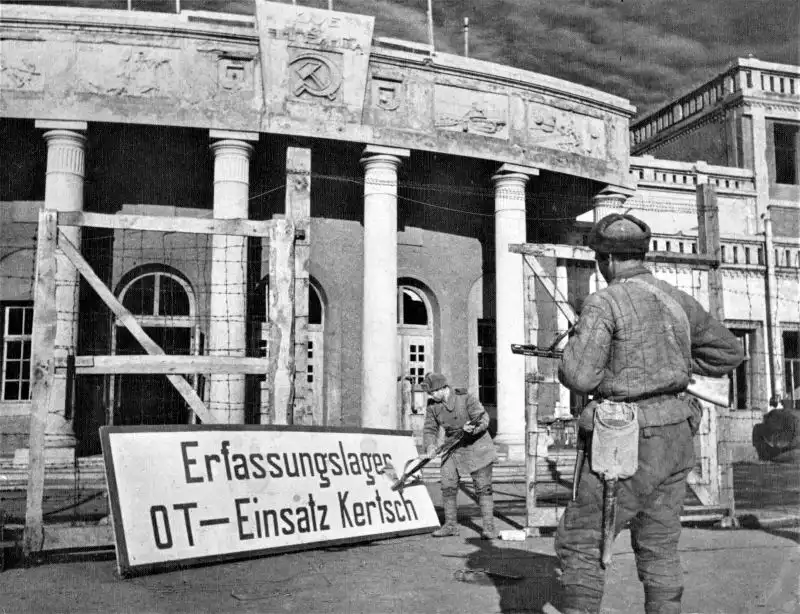
This World War II photograph captures soldiers of the 2nd Guards Tamanskaya Rifle Division removing a German occupation sign from the Engels Club in Kerch, Crimea, shortly after the city's liberation in April 1944. During the occupation, the building had been converted into a prison for Soviet prisoners of war, making the removal of Nazi symbols a powerful public declaration that German rule had come to an end.
The Liberation of Kerch
Kerch was one of the most fiercely contested cities of the Eastern Front. Control of the city meant control of the eastern entrance to Crimea and access across the Kerch Strait. Following the Soviet victory on the Taman Peninsula in late 1943, Red Army forces established bridgeheads on the Crimean coast, preparing for the offensive that would ultimately liberate the peninsula.
On 11 April 1944, Soviet troops entered Kerch during the Crimean Offensive. German forces withdrew westward toward Sevastopol, leaving behind damaged infrastructure, abandoned equipment, and numerous symbols of occupation that were quickly removed by Soviet soldiers and local residents.
The 2nd Guards Tamanskaya Rifle Division
The 2nd Guards Tamanskaya Rifle Division had already earned a distinguished combat reputation during earlier fighting in the Caucasus and on the Taman Peninsula, from which it received the honorary title "Tamanskaya." By the spring of 1944, the division was among the experienced Guards formations participating in the liberation of Crimea.
Its soldiers took part in street fighting, secured strategic buildings, and helped restore Soviet authority in the city. Photographs such as this one preserve not a combat scene, but the immediate aftermath of victory, when military success became visible in everyday urban life.
A Symbolic End to Occupation
Removing enemy signs, flags, and official markings was often one of the first acts performed after a city's liberation. Such gestures carried enormous symbolic importance. They demonstrated to local civilians that occupation had ended and that Soviet administration had returned.
In this case, the act was especially meaningful because the Engels Club had served as a prison for Soviet prisoners of war during the German occupation. Tearing down the German sign represented not only military victory but also the restoration of the city's identity after years of hardship.
Technical photo data:
📍 Location: Kerch, Crimea, USSR
📅 Date: April 1944
📝 Event: Soldiers of the 2nd Guards Tamanskaya Rifle Division remove a German occupation sign after the liberation of Kerch during the Crimean Offensive.
📷 Photographer: Yevgeny Khaldei
📚 Source: dialog-pokoleniy.ru