Soviet Guardsmen of the 2nd Taman Division with PPSh-41 submachine guns during the battle for the Kerch bridgehead, Crimea, November 1943.
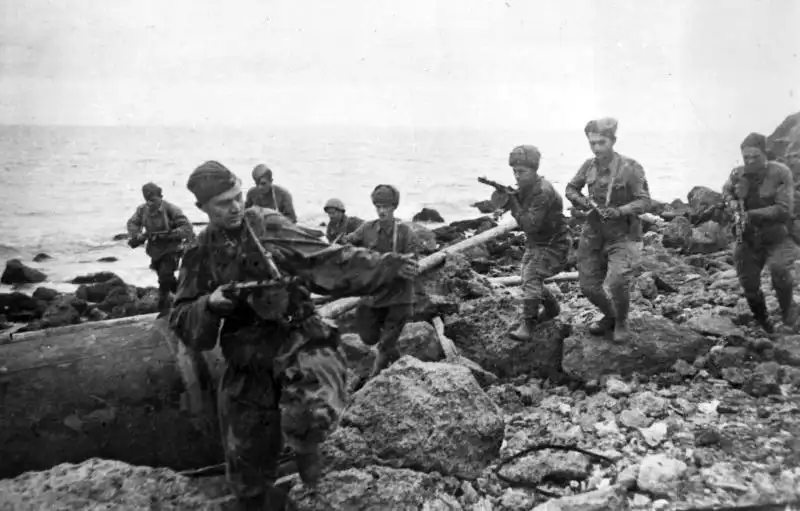
This powerful wartime photograph captures Guardsmen of the 2nd Guards Taman Rifle Division during the bitter fighting for the Kerch bridgehead in November 1943. Armed with PPSh-41 submachine guns, the Soviet infantrymen pressed forward after crossing the Kerch Strait, securing one of the first footholds that would eventually allow the Red Army to reclaim the Crimean Peninsula from German occupation.
The division had only recently completed one of its greatest achievements. After months of heavy fighting in the Kuban region, it played a major role in breaking through the formidable German defensive system known as the Blue Line on the Taman Peninsula. In recognition of its outstanding performance during that campaign, the formation received the honorary title "Taman". Barely had the fighting ended before its soldiers were committed to yet another demanding offensive across the narrow waters separating the Caucasus from Crimea.
The Kerch-Eltigen landing operation, launched in late 1943, represented one of the Red Army's most ambitious amphibious assaults of the war. Troops crossed the often stormy Kerch Strait under enemy artillery fire and air attacks before establishing bridgeheads on the Crimean coast. German forces immediately launched determined counterattacks, making every trench, ridge, and coastal village the scene of intense fighting.
Visible throughout the photograph are the famous PPSh-41 submachine guns. Nicknamed "Papasha" by Soviet soldiers, the weapon became one of the symbols of the Red Army during the Second World War. Its exceptionally high rate of fire and reliable operation in mud, snow, and freezing temperatures made it particularly valuable during assaults, trench fighting, and urban combat. While the large 71-round drum magazine increased weight, it allowed Soviet assault troops to deliver overwhelming firepower at close range before needing to reload.
Although the bridgehead remained under constant pressure for several months, it tied down substantial German forces and provided an essential base for the large-scale Crimean Offensive launched in April 1944. That offensive culminated in the liberation of Sevastopol in May and the complete expulsion of German forces from Crimea.
This photograph therefore captures more than a group of Soviet infantrymen. It represents a crucial stage in the long campaign that began on the Taman Peninsula, crossed the Kerch Strait, and ended with the liberation of Crimea. For the veterans of the 2nd Guards Taman Rifle Division, these battles formed part of a continuous advance that steadily pushed the Wehrmacht back toward Germany.
Technical photo data:
📍 Location: Kerch Peninsula, Crimea, USSR
📅 Date: November 1943
📝 Event: Battle for the Kerch bridgehead during the Kerch-Eltigen landing operation
📷 Author: Unknown Soviet military photographer
Recommended literature:
- David M. Glantz – The Red Army's Amphibious Campaigns 1941–1945
- Earl F. Ziemke – Stalingrad to Berlin: The German Defeat in the East
- John Erickson – The Road to Berlin
- Robert Forczyk – Where the Iron Crosses Grow: The Crimea 1941–44
- Kerch Strait landing WWII
- Soviet Guardsmen Crimea 1943
- Battle for Kerch bridgehead photo
- 2nd Taman Division Red Army
- PPSh-41 Soviet submachine gun
- Liberation of Crimea 1944