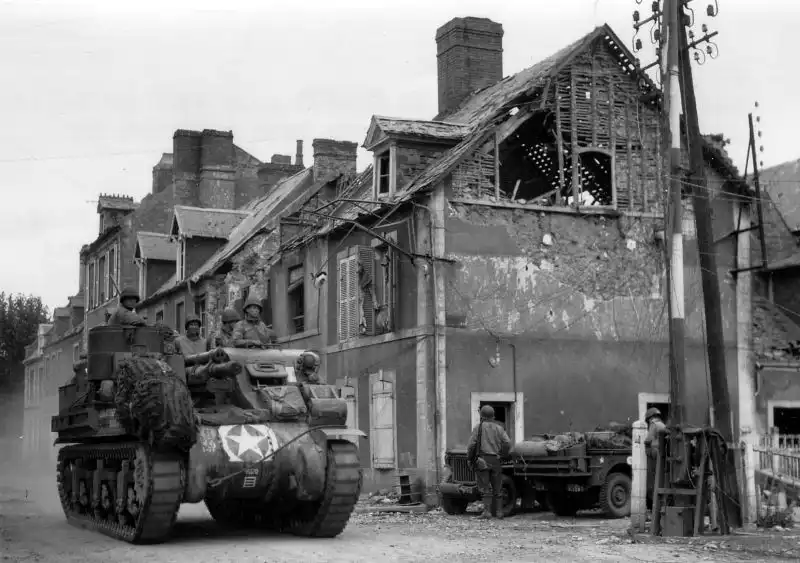
An M7 Priest 105mm self-propelled gun from the 14th Field Artillery Battalion, 2nd Armored Division “Hell on Wheels,” moves through the ruins of Cherbourg during the Allied push to capture the strategic port.
M7 Priest in the Battle for Cherbourg
Cherbourg, France — June 18, 1944. An M7 Priest 105 mm self-propelled howitzer of the 14th Field Artillery Battalion, attached to the 2nd U.S. Armored Division "Hell on Wheels", advances through the damaged streets of Cherbourg during the Allied campaign to seize one of France's most important deep-water ports.
Following the Normandy landings, Allied planners regarded Cherbourg as a critical objective. Its harbor was essential for unloading the enormous quantities of troops, fuel, ammunition, and supplies required to sustain the advance across Western Europe. German forces, recognizing the port's importance, defended the city fiercely and sabotaged many of its facilities before surrendering.
The M7 Priest Self-Propelled Gun
The M7 Priest combined the chassis of the M3 Lee medium tank with a 105 mm M2A1 howitzer, giving American armored formations highly mobile artillery support. Its distinctive machine-gun ring mount resembled a church pulpit, inspiring British troops to nickname the vehicle "Priest"—a name that was later adopted officially.
Unlike conventional towed artillery, the M7 could move alongside advancing armored units, rapidly deploy into firing positions, and provide continuous indirect fire as the battle developed.
Fighting Through the Port City
The railway crossing visible beside the vehicle belonged to the transport network linking Cherbourg with the rest of occupied France. During the battle, railways, roads, and industrial facilities became frequent targets as both sides attempted to control the city's transportation infrastructure.
American artillery units played an essential role in reducing German strongpoints, supporting infantry assaults, and clearing the final defensive positions before Cherbourg fell to Allied forces later in June 1944.
Technical Information
📷 Photographer: Unknown U.S. Army photographer
🌐 Source: U.S. National Archives / Wikimedia Commons
📅 Date: June 18, 1944
📍 Location: Cherbourg, France
Historical Significance
This photograph documents the employment of the M7 Priest during the Battle of Cherbourg, illustrating the importance of self-propelled artillery in the Allied campaign after D-Day. It also preserves a view of the heavily damaged port city before its harbor was restored to become one of the principal logistical hubs supporting the liberation of Western Europe.