Soviet female bomber pilot Yevdokiya Mamaeva-Bezmenova prepares her parachute before a combat mission in an American A-20 Boston bomber at Krasnodar Airfield, August 1943.
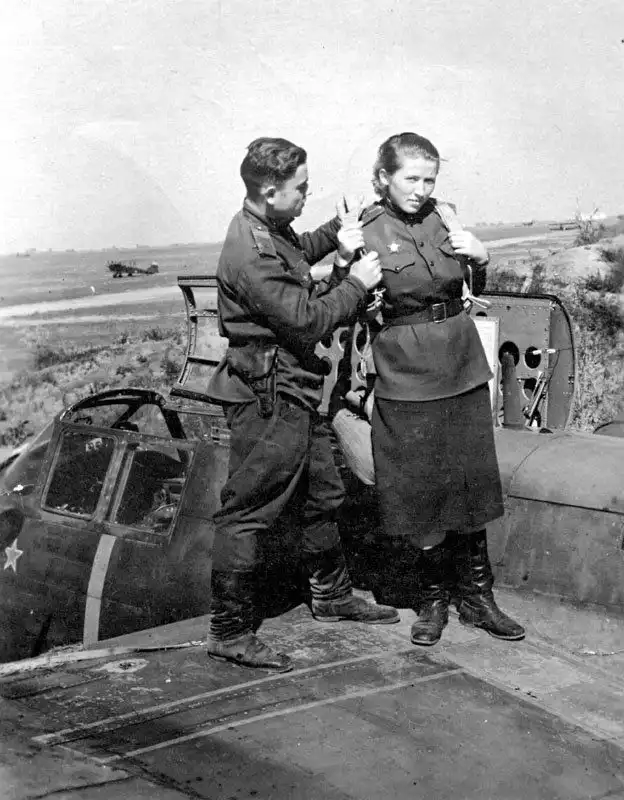
This remarkable World War II photograph captures Soviet bomber pilot Yevdokiya Dmitrievna Mamaeva-Bezmenova preparing for another combat mission at the central airfield of Krasnodar, USSR, in August 1943. As aerial gunner Potapenko helps her secure her parachute, the image preserves one of the final quiet moments before takeoff. Behind them stands an American-built A-20 Boston bomber supplied under the Lend-Lease program, while a Soviet U-2 biplane can be seen in the background, illustrating the diverse aircraft operated by the Red Army Air Force during the war.
Women in Soviet Combat Aviation
The Soviet Union became the only major combatant of World War II to employ large numbers of women in frontline aviation roles. Female pilots, navigators, bombardiers, radio operators, and mechanics served in fighter, bomber, reconnaissance, and night bomber regiments throughout the conflict. Their participation challenged traditional military roles and demonstrated that skill, discipline, and courage mattered far more than gender under wartime conditions.
Yevdokiya Mamaeva-Bezmenova served with the 244th Bomber Aviation Regiment, flying dangerous combat missions against German forces. Like thousands of other Soviet aviators, she faced enemy fighters, anti-aircraft fire, poor weather, and the constant risks of mechanical failure. Every mission demanded precise coordination between the pilot and the rest of the crew, making teamwork essential for survival.
The A-20 Boston in Soviet Service
The Douglas A-20 Boston was one of the most successful combat aircraft delivered to the Soviet Union under the Lend-Lease program. Nearly 3,000 examples reached the USSR, where Soviet aircrews quickly developed a high opinion of the aircraft. Fast, reliable, and heavily armed, the Boston proved highly effective as a light bomber, attack aircraft, reconnaissance platform, and even as a night intruder. Many Soviet pilots considered it one of the finest foreign aircraft they flew during the war.
The presence of both the American-built A-20 Boston and the Soviet-designed U-2 in the same photograph perfectly illustrates the multinational character of the Red Army Air Force in 1943. Domestically produced aircraft operated alongside thousands of Allied machines, reflecting the enormous contribution of Lend-Lease equipment to Soviet military aviation.
Preparing for a Combat Sortie
Although the scene appears calm, it captures one of the most critical moments of every combat mission. Before each sortie, aircrews carefully checked parachutes, flight equipment, communications gear, maps, and personal weapons. Small mistakes during these preparations could have fatal consequences once the aircraft left the ground. Photographs like this remind us that victory depended not only on combat itself but also on the professionalism and discipline displayed long before takeoff.
A Quiet Moment Before Battle
Unlike dramatic images taken during combat, this photograph reveals the human side of military aviation. There are no explosions or enemy aircraft—only comrades preparing another crew member for a dangerous mission. Such scenes emphasize the routine that defined wartime service: endless preparation, mutual trust, and the awareness that every flight might be the last. For historians today, these quiet moments often provide a deeper understanding of daily life in wartime than battlefield photographs alone.
Technical photo data:
📍 Location: Krasnodar, USSR
📅 Date: August 1943
📝 Event: Pre-flight preparation of Soviet female bomber pilot Yevdokiya Mamaeva-Bezmenova before a combat mission in an American A-20 Boston bomber
📷 Author: Unknown
Recommended literature:
- Richard Overy — Russia's War
- Roger A. Freeman — The Mighty Eighth War Diary
- Edward M. Young — The A-20 Havoc
- Christer Bergström — Black Cross / Red Star
- David M. Glantz — When Titans Clashed