American Douglas A-20G “Boston” medium bomber of the USAAF (serial number 286657) in flight over the United States during World War II.
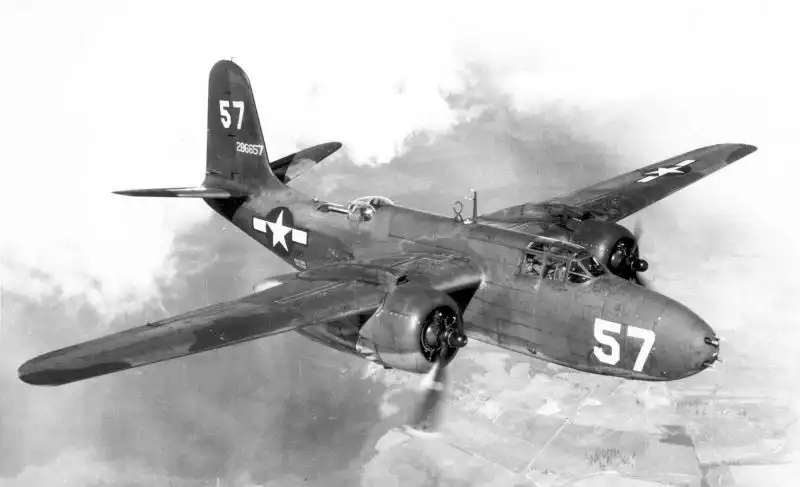
This World War II photograph captures a Douglas A-20G medium bomber (serial number 286657) of the United States Army Air Forces (USAAF) in flight over the continental United States. Known as the Havoc in American service and the Boston in British and Soviet use, the aircraft became one of the most versatile and successful twin-engine combat aircraft of the Second World War. Fast, durable, and easy to maintain, it served on nearly every major front of the conflict.
Design and Firepower
The A-20G represented one of the most heavily armed versions of the aircraft. Instead of the glazed bombardier's nose found on earlier models, it featured a solid nose housing six 12.7 mm (.50 caliber) Browning machine guns, giving it exceptional firepower during low-level attack missions. Powered by two Wright R-2600 Double Cyclone radial engines, the bomber combined excellent speed, agility, and reliability while carrying bomb loads of up to 900 kg (2,000 lb).
Combat Service Around the World
The Douglas A-20 fought on virtually every major theater of World War II. USAAF crews employed it in North Africa, Italy, Western Europe, and the Pacific, where it excelled in low-level bombing, strafing, maritime patrol, and night intruder operations. Its combination of speed and maneuverability allowed it to survive missions that proved dangerous for many larger bombers.
The Boston in Soviet Service
Under the Lend-Lease program, approximately 3,000 A-20 aircraft were delivered to the Soviet Union, making it one of the most important Western aircraft supplied to the Red Army Air Force. Soviet crews highly valued the Boston for its reliability, excellent handling characteristics, and powerful defensive armament. It was widely employed as a level bomber, torpedo bomber with Soviet Naval Aviation, reconnaissance aircraft, and night bomber. Many Soviet pilots considered it among the finest foreign aircraft they operated during the war.
A Symbol of Allied Industrial Cooperation
The A-20 Boston demonstrates how Allied industrial production directly influenced the outcome of World War II. Designed and manufactured in the United States, operated by American, British, Soviet, Free French, and other Allied air forces, the aircraft became a truly international weapon. Thousands served on battlefields separated by thousands of kilometers, illustrating how cooperation in manufacturing and logistics became just as important as battlefield tactics in securing Allied victory.
Technical photo data:
📍 Location: United States
📅 Date: circa 1943
📝 Aircraft: Douglas A-20G Havoc (Boston), serial number 286657
📷 Author: Unknown
Recommended literature:
- Edward M. Young — The A-20 Havoc
- René J. Francillon — Douglas Aircraft Since 1920
- Roger Freeman — The Mighty Eighth War Diary
- David M. Glantz — When Titans Clashed
- Richard Overy — Why the Allies Won