Exhausted Soviet Pe-2 crew from the 11th Independent Reconnaissance Aviation Regiment after a dangerous combat sortie, August 1944.
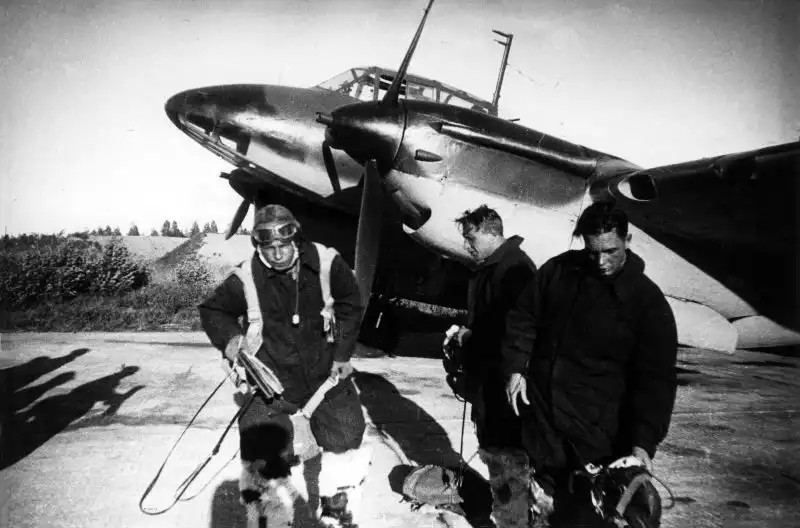
This remarkable World War II photograph captures the exhausted crew of a Soviet Petlyakov Pe-2 from the 11th Independent Reconnaissance Aviation Regiment (11th ORAP) after returning from a dangerous combat mission on August 13, 1944. Rather than celebrating victory, the men display the unmistakable fatigue that came with flying deep into enemy-controlled territory, where a single reconnaissance flight could prove as hazardous as a bombing raid.
The men shown are:
- Senior Lieutenant Alexander Rakov — pilot and aircraft commander;
- Lieutenant Nikolai Blishchavenko — navigator;
- Sergeant Krylov — radio operator and aerial gunner.
The 11th Independent Reconnaissance Aviation Regiment
The 11th ORAP specialized in tactical and operational aerial reconnaissance for the Red Army Air Force. Its crews flew far beyond the front line to photograph German troop concentrations, bridges, railway junctions, artillery positions, and supply depots. The intelligence gathered during these dangerous flights often determined where Soviet commanders would launch their next offensive, making reconnaissance crews an essential part of Red Army operations.
The Pe-2 "Peshka"
The Petlyakov Pe-2, affectionately nicknamed "Peshka" ("the Pawn") by Soviet airmen as a play on its designation "Pe," became one of the Soviet Union's most successful twin-engine combat aircraft. Although originally designed as a dive bomber, it proved equally effective in reconnaissance missions thanks to its high speed, excellent maneuverability, and ability to survive over heavily defended enemy territory.
Reconnaissance Under Fire
Unlike bomber crews assigned to attack a specific target, reconnaissance airmen had to maintain a precise course long enough for aerial cameras to capture detailed photographs. Flying alone or in very small formations, they became prime targets for German fighters and anti-aircraft batteries. Every successful mission brought invaluable intelligence, but also carried enormous personal risk.
Only Twenty Days Later
Senior Lieutenant Rakov joined the 11th ORAP in May 1943 and soon became one of its most experienced reconnaissance pilots. Tragically, just twenty days after this photograph was taken, on September 3, 1944, his Pe-2 was shot down by German anti-aircraft fire near the Latvian town of Skrunda. Navigator Nikolai Blishchavenko and Sergeant Krylov were killed. Rakov survived, was captured by German forces, but escaped from captivity on April 8, 1945 and eventually returned to Soviet lines.
A Photograph Beyond the Battlefield
Unlike many wartime images showing victorious crews posing beside their aircraft, this photograph captures something far more personal. Dust-covered uniforms, tired faces, and relaxed postures reveal the physical and emotional exhaustion shared by countless combat aviators. Knowing the fate that awaited this crew only weeks later transforms the image from a simple portrait into a powerful reminder of the human cost of aerial warfare.
Technical photo data:
📍 Location: USSR
📅 Date: August 13, 1944
📝 Aircraft: Petlyakov Pe-2 reconnaissance aircraft, 11th Independent Reconnaissance Aviation Regiment (11th ORAP)
📷 Author: Boris Vdovenko
📝 Source: A. Kalinovsky's "FOTAB" project
Recommended literature:
- Yefim Gordon & Sergey Komissarov — Petlyakov Pe-2
- Viktor Markovsky — Pe-2: Frontline Bomber
- Christer Bergström — Bagration to Berlin: The Final Air Battles in the East
- Richard Overy — The Air War: 1939–1945
- David M. Glantz — Belorussia 1944: The Soviet General Staff Study