Soviet pilots with U.S. Technical Sergeant Bernard J. McGuire in front of a Petlyakov Pe-2 bomber, Poltava, June 1944.
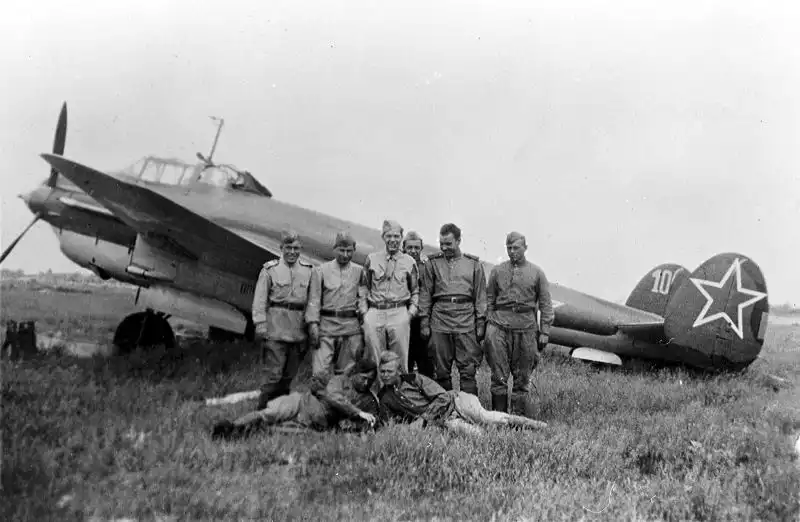
This remarkable wartime photograph captures Soviet aviators posing alongside U.S. Technical Sergeant Bernard J. McGuire of Tonawanda, New York, in front of a Petlyakov Pe-2 bomber at Poltava Airfield in June 1944. McGuire served with the 348th Squadron of the 99th Bomb Group and was among the American personnel participating in one of the most unusual Allied cooperative operations of the Second World War. The image is a rare visual record of Soviet and American servicemen working side by side during a period when the two nations were united against Nazi Germany.
The meeting took place during Operation Frantic, a series of shuttle bombing missions that linked Allied air bases in Britain, Italy, and the Soviet Union. Instead of returning to their original bases after attacking targets deep inside German-occupied Europe, American heavy bombers landed at Soviet airfields, where they were refueled, repaired, and prepared for new missions. Poltava became the most important of these Soviet bases, transforming into a unique center of Allied military cooperation in 1944.
The aircraft behind the group is the famous Petlyakov Pe-2, the principal twin-engine dive bomber of the Soviet Air Force. Fast, versatile, and capable of carrying out precision bombing missions, the Pe-2 served on virtually every major sector of the Eastern Front. Thousands were produced during the war, and their crews participated in operations ranging from tactical support of advancing infantry to attacks on bridges, railways, and fortified positions. For many American visitors, seeing the Pe-2 firsthand offered a rare opportunity to examine one of the Soviet Union's most successful combat aircraft.
Interestingly, this photograph has occasionally been misidentified in books and online publications, with the aircraft incorrectly described as a Yak-4. Careful examination of its fuselage, cockpit arrangement, engine nacelles, and tail section, however, confirms that it is unmistakably a Petlyakov Pe-2. Correctly identifying aircraft in historical photographs is more than a technical detail—it helps preserve the accuracy of the historical record and prevents long-standing errors from being repeated.
Although Operation Frantic demonstrated the willingness of the Allies to cooperate against a common enemy, it also revealed the practical difficulties of coordinating military operations between countries with different doctrines, command structures, and security concerns. Even so, thousands of Soviet and American servicemen met, exchanged experiences, and worked together on the same airfields, creating moments of genuine personal friendship that survived long after the war had ended.
This photograph therefore documents much more than a posed group portrait. It symbolizes a brief period when Soviet and American airmen shared the same mission, supported one another in combat, and contributed together to the defeat of Nazi Germany. Today it remains an important reminder that cooperation between nations with different political systems once played a decisive role in achieving victory during the largest conflict in modern history.
Technical photo data:
📍 Location: Poltava, Ukrainian SSR, USSR
📅 Date: June 1944
📝 Event: Allied cooperation at Poltava Airfield during Operation Frantic
📷 Source: National Museum of the U.S. Air Force
Recommended reading: