Deceased German soldiers on the battlefield of the Blue Line fortifications, Taman Peninsula, October 1943.
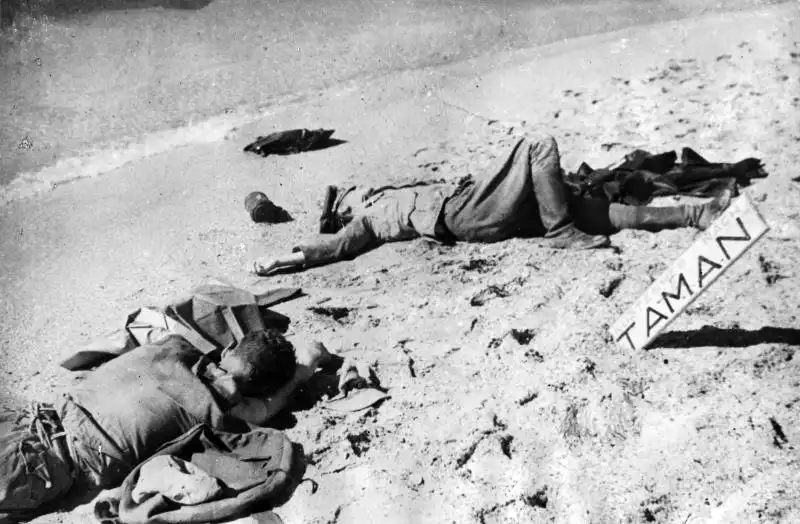
This powerful wartime photograph records the aftermath of the fighting on the German defensive system known as the Blue Line on the Taman Peninsula in October 1943. The bodies of fallen German soldiers scattered across the battlefield offer a stark reminder of the violence that accompanied the final Soviet offensive in the Kuban region. Rather than depicting combat itself, the image captures its consequences—silence after the battle and the devastating human cost paid by both armies.
The Blue Line was among the strongest German defensive systems constructed on the Eastern Front. Stretching across the narrow approaches to the Taman Peninsula, it consisted of multiple trench lines, reinforced bunkers, artillery positions, minefields, anti-tank obstacles, and carefully prepared strongpoints connected into a unified defense. German command concentrated substantial forces in the area, hoping to delay the Red Army long enough to secure the evacuation of troops to Crimea if necessary.
Breaking through these fortifications required months of determined Soviet operations involving infantry, artillery, armor, engineers, and aviation. The campaign became one of the most difficult phases of the Battle of the Caucasus, as every ridge, village, and fortified position had to be captured under intense enemy fire. Soviet formations, including the 2nd Guards Rifle Division, gradually wore down the defenders before finally forcing the collapse of the German line.
By October 1943, the German bridgehead on the Taman Peninsula had become untenable. Under constant pressure from advancing Soviet forces, the Wehrmacht completed the evacuation of surviving units across the Kerch Strait to Crimea. Although the withdrawal preserved part of the German force, it marked the complete liberation of the Kuban and removed the last major Axis foothold in the North Caucasus.
Today, photographs such as this serve not only as military documentation but also as reminders of the terrible human cost of warfare. They illustrate that behind every advance on a battlefield stood thousands of individual lives lost, regardless of nationality. For historians, these images remain valuable evidence of the intensity of the fighting that accompanied the liberation of the Taman Peninsula.
Technical photo data:
📍 Location: Taman Peninsula, Krasnodar Krai, USSR
📅 Date: October 1943
📝 Event: Aftermath of the Soviet breakthrough of the German Blue Line defensive system
📷 Source: Soviet WWII photo archives
Recommended literature:
- David M. Glantz — The Battle for the Caucasus 1942–1943
- Robert Forczyk — Where the Iron Crosses Grow: The Crimea 1941–44
- Earl F. Ziemke — Stalingrad to Berlin: The German Defeat in the East
- John Erickson — The Road to Berlin
- Taman Peninsula WWII battles
- Blue Line German fortifications
- German withdrawal from Taman Peninsula 1943
- 2nd Guards Rifle Division operations
- Liberation of the Kuban
- Eastern Front battlefield aftermath
- Battle of the Caucasus 1943
- German defensive positions on the Taman Peninsula
- Red Army offensive operations Kuban
- WWII battlefield historical photographs