Paul Tibbets and the Enola Gay Before the Atomic Bombing of Hiroshima
January 2, 2026 - Reading time: 11 minutes
Paul Tibbets waves from the Enola Gay moments before the atomic bombing of Hiroshima, marking the beginning of the nuclear age.
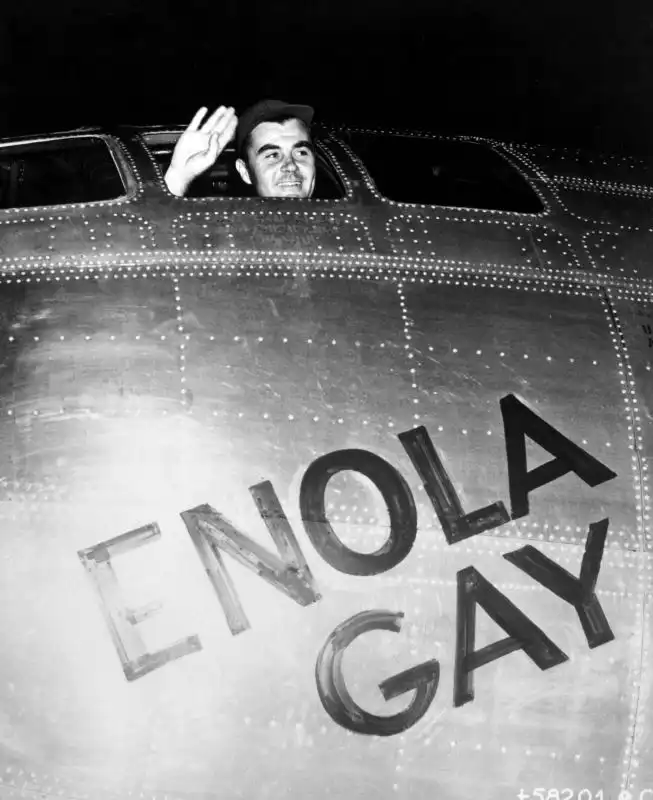
On August 6, 1945, U.S. Army Air Forces pilot Colonel Paul Tibbets waved from the cockpit of the B-29 Superfortress Enola Gay moments before taking off on the most consequential bombing mission in history — the atomic attack on Hiroshima, Japan.
This photograph captures the final calm seconds before an event that would change warfare, geopolitics, and human history forever.
Paul Tibbets: The Man Behind the Mission:
Paul Warfield Tibbets Jr. (1915–2007) was one of the most experienced bomber pilots in the U.S. Army Air Forces. Selected personally to command Special Mission No. 13, he was chosen for his discipline, technical skill, and ability to carry out orders without hesitation.
On August 5, 1945, Tibbets named his aircraft “Enola Gay” after his mother, Enola Gay Tibbets — a personal gesture made just hours before the mission.
The Enola Gay and the Atomic Bomb:
The B-29 Enola Gay was specially modified to carry the atomic bomb “Little Boy”:
-
Removed armor and gun turrets to reduce weight
-
Modified bomb bay and release mechanisms
-
Enhanced engines and propellers
The aircraft took off from Tinian Island, part of the Mariana Islands, accompanied by support and observation aircraft.
The Moment Captured in the Photograph:
This image shows Paul Tibbets:
-
Sitting in the cockpit of the Enola Gay
-
Calmly waving moments before takeoff
-
Unaware of the full human consequences that would unfold hours later
The photograph is often interpreted as a symbol of:
-
The mechanization of warfare
-
The distance between decision-makers and consequences
-
The transition into the nuclear age
The Bombing of Hiroshima:
At 08:15 local time, the atomic bomb detonated over Hiroshima:
-
Tens of thousands were killed instantly
-
The city was largely destroyed
-
Long-term radiation effects followed for decades
The bombing of Hiroshima, followed by Nagasaki three days later, led to Japan’s surrender and the end of World War II — but also opened an era of nuclear fear and ethical debate that continues today.
Historical and Moral Debate:
Paul Tibbets remained unapologetic throughout his life, stating that he believed the mission:
-
Shortened the war
-
Saved lives by preventing a land invasion
-
Fulfilled his duty as a military officer
Historians, ethicists, and the public remain deeply divided over the bombing’s necessity and morality.
Historical Significance:
This photograph is important because it captures:
-
The human face of nuclear warfare
-
The moment before the world irreversibly changed
-
One of the most documented and debated military missions in history
It is not a victory image — it is a threshold image.
Photo Information:
-
📝 Subject: Paul Tibbets in the cockpit of B-29 Enola Gay
-
📍 Location: Tinian Island, Mariana Islands
-
📅 Date: August 6, 1945
-
✈ Aircraft: B-29 Superfortress
The image of Paul Tibbets before takeoff is one of the most haunting photographs of the 20th century. It represents the moment humanity crossed a line — from conventional war into the nuclear era — a line that can never be uncrossed.
👉 Related: Atomic bombings of Japan • B-29 Superfortress history • World War II turning points
Related Pages
Tags
Category
Search
Categories
- Unidentified WWII Photos (14)
- World War II Photos 1937 (1)
- World War II Photos 1938 (1)
- World War II Photos 1939 (3)
- World War II Photos 1940 (5)
- World War II Photos 1941 (103)
- World War II Photos 1942 (60)
- World War II Photos 1943 (55)
- World War II Photos 1944 (77)
- World War II Photos 1945 (43)
- WWII and Postwar Photos 1946 (1)