German machine gunner with MG-34 mounted on tripod and optic sight in a trench, WWII.
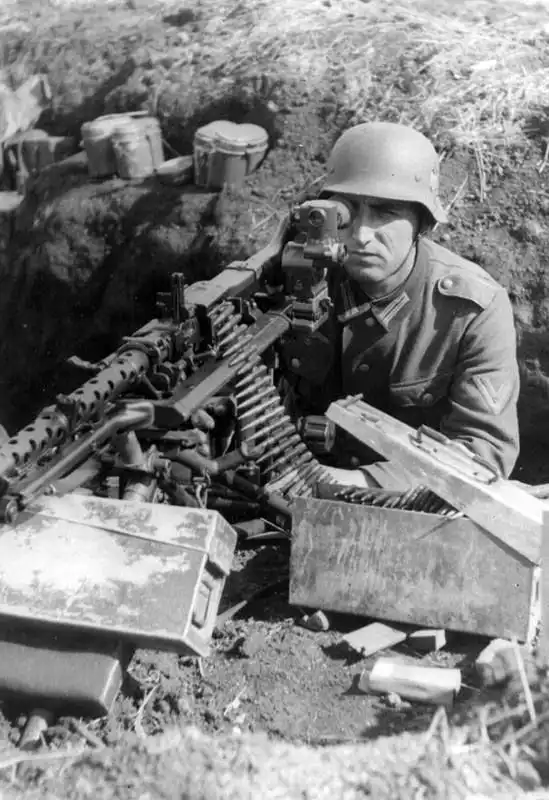
This photograph depicts a German infantry machine gunner from the Wehrmacht, positioned behind an MG-34 mounted on a Lafette tripod inside a frontline trench during World War II. Introduced into service in 1934, the MG-34 became the world's first true general-purpose machine gun. Designed to perform both light and heavy machine-gun roles, it represented a major leap forward in infantry firepower and heavily influenced military weapon development around the world.
The soldier wears standard Wehrmacht field equipment, including the iconic Stahlhelm helmet, while the weapon is fitted with an optical sight for indirect and long-range fire. When mounted on its tripod, the MG-34 could deliver highly accurate sustained fire, allowing German infantry units to suppress enemy positions at distances that were often difficult to answer effectively. In German doctrine, the machine gun formed the centerpiece of the infantry squad, with riflemen supporting and protecting the gun rather than the other way around.
The MG-34 earned a formidable reputation thanks to its exceptional versatility. It could be carried with a bipod during assaults, mounted on the Lafette tripod for defensive operations, or installed in armored vehicles as a coaxial or hull-mounted weapon. Its cyclic rate of fire, which could reach approximately 800–900 rounds per minute, combined with excellent manufacturing quality and accuracy, made it one of the most advanced machine guns of its era.
However, these advantages came at a price. The MG-34 was manufactured with extremely tight tolerances and required extensive machining, making production both slow and expensive. Under harsh battlefield conditions—particularly mud, sand, or heavy dust—it also demanded careful maintenance to remain reliable. These shortcomings eventually led Germany to develop the simpler and cheaper MG-42, which entered service in 1942 while the MG-34 continued to serve alongside it throughout the remainder of the war.
Although this photograph was likely staged for propaganda or documentation purposes, it accurately illustrates how German heavy machine-gun positions were organized. It also reflects the tactical philosophy of the Wehrmacht, where concentrated automatic fire formed the backbone of infantry combat and often determined the success or failure of defensive engagements on both the Eastern and Western Fronts.
The image remains a valuable historical document, offering insight into German infantry doctrine, battlefield engineering, and the evolution of one of the most influential machine guns ever fielded during the Second World War.
Technical photo data:
📍 Location: Unknown, likely on the Eastern Front
📅 Date: Approximately 1941–1943
📝 Subject: Wehrmacht machine gunner operating an MG-34 on a Lafette tripod in a frontline trench
📷 Photographer: Unknown (likely German military press or propaganda photographer)
Recommended literature:
- George M. Chinn — The Machine Gun, Volume V
- Chris McNab — MG 34 and MG 42 Machine Guns
- Ian V. Hogg — German Infantry Weapons of World War II
- Terry Gander & Peter Chamberlain — Weapons of the Third Reich
MG-34 machine gun photo
Wehrmacht machine gunner trench
German WWII equipment
Staged German military photos
Eastern Front German weapons
MG-34 vs MG-42 history