German MG-34 machine gun crew during Operation Barbarossa, positioned atop a fortress bastion in Narva. The assistant carries a spare barrel container, essential for maintaining the high rate of fire of the MG-34.
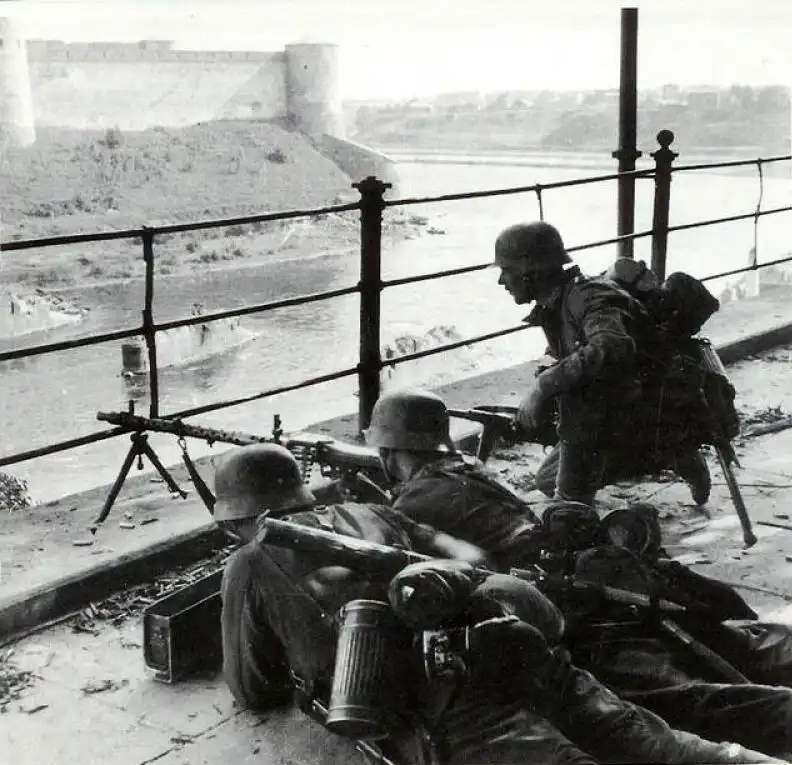
German MG-34 Crew at Narva During Operation Barbarossa
Narva, 1941.
Perched atop one of the old fortress bastions overlooking the Narva River, a German machine-gun team prepares for combat during the opening months of Operation Barbarossa. Below them lies a damaged bridge linking Narva with Ivangorod, while the eastern bank remains in Soviet hands. The photograph captures a brief pause before battle in one of the northern sectors of the German advance into the Soviet Union.
The MG-34: Germany's Revolutionary General-Purpose Machine Gun
At the center of the image is the legendary MG-34, widely regarded as the world's first true general-purpose machine gun adopted for large-scale military service. Capable of firing up to 900 rounds per minute, it delivered exceptional firepower in both light and sustained support roles. Its remarkable versatility, however, came at the cost of mechanical complexity and demanding maintenance.
The assistant gunner carries a spare barrel container across his back. Quick barrel changes were essential during prolonged firing because the MG-34's barrel overheated rapidly. This detail illustrates the practical realities of operating one of the most advanced infantry weapons of the Second World War.
German Infantry Tactics on the Eastern Front
Standing beside the machine gunner is another soldier armed with an MP 40 submachine gun, providing close protection for the gun crew. Such teams formed the core of Wehrmacht infantry firepower, with the rifle squad built largely around the machine gun rather than the individual rifleman.
Beyond its military significance, the photograph also preserves the historical landscape of Narva. The centuries-old fortress walls, the ruined bridge, and the quiet river form a striking contrast to the violence that soon engulfed the region. It is a reminder that historic cities often became battlefields where architecture, civilians, and soldiers alike were swept into the destruction of war.
Historical Significance
This image illustrates both the technological sophistication of early-war German infantry weapons and the strategic importance of the Narva crossing during the initial phase of Operation Barbarossa. While the soldiers shown here appear calm and prepared, the brutal fighting on the Eastern Front would soon transform the optimism of 1941 into one of the longest and bloodiest campaigns in military history.
Technical Photo Data
📷 Technical photo data:
📸 Photographer: Unknown German war correspondent
📅 Date: 1941
📍 Location: Narva, Estonian SSR, USSR
Recommended Literature
- Chris McNab — MG 34 and MG 42 Machine Guns
- David Stahel — Operation Barbarossa and Germany's Defeat in the East
- Robert Forczyk — Case Red: The Collapse of France (for MG-34 operational doctrine)
- Steven J. Zaloga — Operation Barbarossa 1941