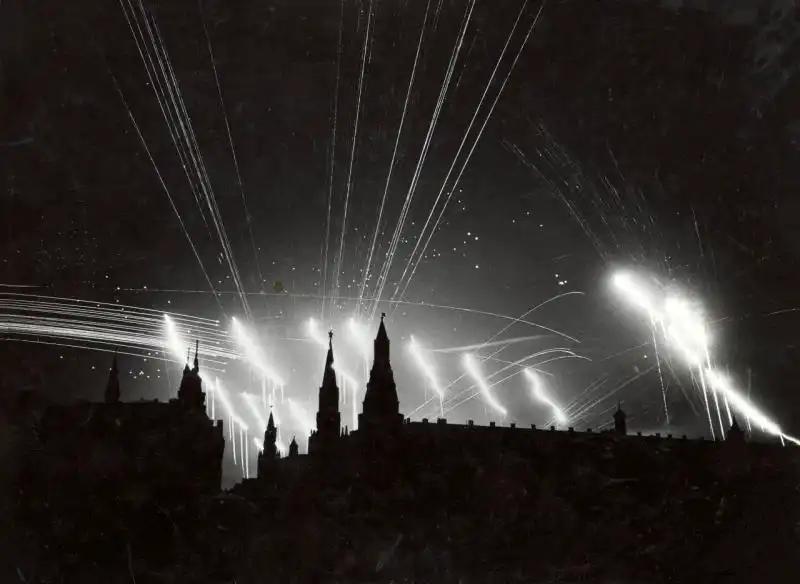
On the night of July 26, 1941, Soviet anti-aircraft guns fired into the skies above Moscow as Luftwaffe bombers illuminated the capital with parachute flares during one of the largest early air raids of the war.
Moscow Under the Night Sky
This striking photograph, taken by renowned American photojournalist Margaret Bourke-White, captures the dramatic night of July 26, 1941, when the Luftwaffe launched one of its largest early bombing raids against Moscow. Unlike daytime combat photographs, this long-exposure image records the battle as streaks of light crossing the darkness, revealing both the attackers and the city's determined defenders.
Seven brilliant arcs visible in the sky are German parachute illumination flares, dropped to expose bridges, factories, railway yards, and government buildings to the bomber crews. At the same time, Soviet small-caliber anti-aircraft batteries opened fire, their shells leaving glowing trails that crisscrossed the night above the capital. The result is both a historical document and an extraordinary piece of wartime photography.
The Defense of Moscow
During the summer and autumn of 1941, the Luftwaffe repeatedly attempted to cripple Moscow through strategic bombing. However, the city's layered air-defense system—combining anti-aircraft artillery, searchlights, barrage balloons, and fighter interceptors—proved far more effective than German planners had expected. Although bombs struck residential districts and industrial facilities, the attackers failed to inflict the decisive damage they had hoped for or to break civilian morale.
The air defense of Moscow became one of the earliest demonstrations that the Soviet capital could withstand sustained aerial assault. Every successful interception and every disrupted bombing run helped preserve vital military production and government institutions during one of the most dangerous periods of the war.
A Photographer at the Front
Margaret Bourke-White was among the first Western photojournalists granted extensive access to the Soviet Union after the German invasion. Her photographs of Moscow under attack became some of the most famous visual records of the Eastern Front published in the West. Together with her companion images of the Kremlin during the same raid, this photograph remains one of the defining portrayals of aerial warfare over the Soviet capital.
Technical photo data:
📝 Source of information: Life magazine archives, wartime photographic records
📍 Location: Moscow, USSR
📅 Date of photo: July 26, 1941
📷 Photographer: Margaret Bourke-White (USA)
Recommended literature:
- Margaret Bourke-White — Shooting the Russian War
- Richard Overy — The Bombing War: Europe 1939–1945
- Rodric Braithwaite — Moscow 1941: A City and Its People at War
- Antony Beevor — The Second World War
- Luftwaffe bombing of Moscow
- German night air raid 1941
- Soviet air defense WWII
- Moscow anti-aircraft artillery
- Parachute illumination flares
- Moscow air raid July 1941
- Margaret Bourke-White Moscow
- Operation Barbarossa air campaign
- German bombers over USSR
- Great Patriotic War air battles