Downed German Ju 88 reconnaissance aircraft near Istra, Moscow region, shot down by Soviet fighters, July 1941.
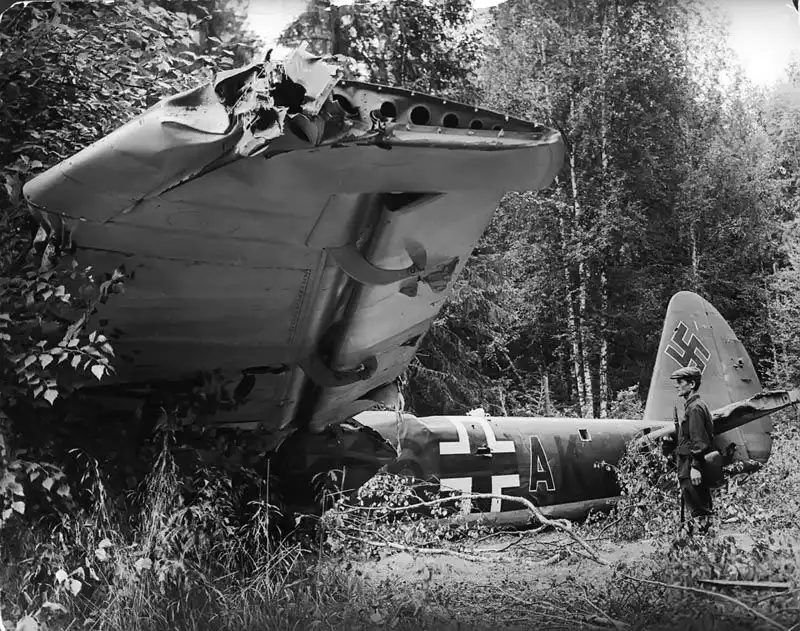
German Ju 88 Reconnaissance Aircraft Shot Down Near Moscow
This World War II photograph shows the wreck of a German Junkers Ju 88 reconnaissance aircraft brought down near Istra, west of Moscow, on 25 July 1941. Carrying the code F6+AK (Werknummer 0285), the aircraft belonged to 2.(F)/122, a long-range reconnaissance squadron of the Luftwaffe.
During a reconnaissance mission over the Moscow–Kaluga sector, the aircraft was intercepted by Soviet fighters from the 3rd Fighter Aviation Corps. Forced down after the engagement, it crash-landed in a forest clearing and remained largely intact.
From Battlefield Wreck to Public Trophy
Only a few days after the crash, Soviet authorities transported the damaged aircraft to Sverdlov Square (today's Teatralnaya Square) in central Moscow. Displayed before thousands of visitors, it became one of the earliest publicly exhibited Luftwaffe aircraft captured during Operation Barbarossa.
Such exhibitions served several purposes. They demonstrated that German aircraft could be defeated, strengthened civilian morale during the difficult opening weeks of the invasion, and offered engineers and intelligence specialists an opportunity to examine enemy technology at close range.
The Crew
The aircraft was flown by:
- Lt. Wilhelm Stuckmann — pilot
- Feldwebel Wilfred Anders — navigator
- Gefreiter Bruno Sievert — radio operator
- Gefreiter Ludwig Werner — gunner
According to surviving German records, all four crew members were officially listed as missing in action (MIA).
The Junkers Ju 88
The Junkers Ju 88 became one of Germany's most versatile combat aircraft during World War II. Originally designed as a fast bomber, it was successfully adapted for reconnaissance, night fighting, torpedo attacks, heavy fighter duties, and many other specialized roles.
Its speed, range, and adaptability made it one of the Luftwaffe's true workhorses. More than 15,000 Ju 88s of all variants were produced during the war, making it one of Germany's most important military aircraft.
Nevertheless, the opening months of Operation Barbarossa demonstrated that even experienced German reconnaissance crews faced increasing risks as Soviet fighter units and anti-aircraft defenses recovered from the initial surprise of the invasion.
Margaret Bourke-White's Camera
This photograph was taken by Margaret Bourke-White, one of the twentieth century's most celebrated photojournalists. Working for Life magazine, she became the first Western photographer permitted to document wartime Moscow after Germany's invasion of the Soviet Union.
Her photographs combined historical importance with remarkable artistic composition, creating some of the most recognizable visual records of the Eastern Front.
Technical photo data
📍 Location: Istra, Moscow Region, USSR
📅 Date: 25 July 1941
✈️ Aircraft: Junkers Ju 88 reconnaissance aircraft (F6+AK, W.Nr. 0285)
📝 Event: German reconnaissance aircraft shot down by Soviet fighters and later displayed in Moscow
📷 Author: Margaret Bourke-White
Recommended literature
- William Green — Warplanes of the Third Reich
- Manfred Griehl — Junkers Ju 88
- Richard Overy — The Air War 1939–1945
- David M. Glantz — Barbarossa Derailed
- Margaret Bourke-White — Portrait of Myself
Related photos
- Captured Ju 88 displayed in Moscow
- Luftwaffe reconnaissance aircraft on the Eastern Front
- Soviet and German aircraft during Operation Barbarossa
- German reconnaissance aviation losses in 1941
- Battle for Moscow air operations