German infantry marching with a Panzerkampfwagen I (Pz.Kpfw. I) light tank during the invasion of the Soviet Union, 1941.
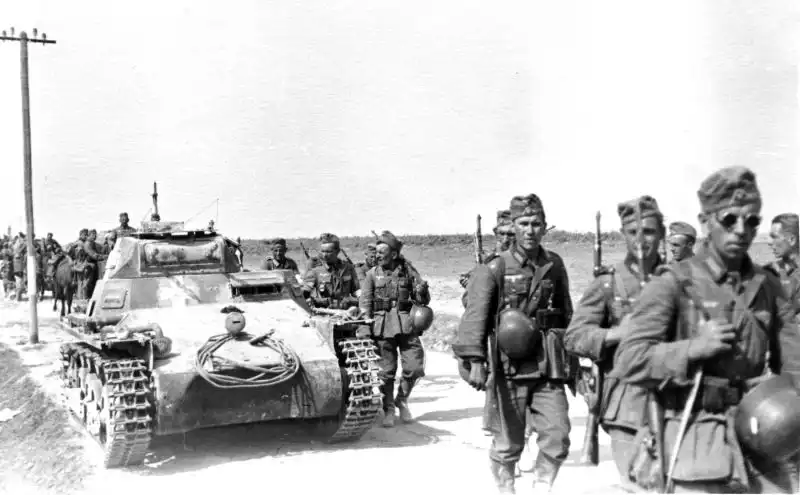
This wartime photograph captures a scene far more representative of the German invasion of the Soviet Union than many popular portrayals. Rather than endless columns of armored vehicles and motorized troops, it shows ordinary Wehrmacht infantry advancing on foot alongside a Panzerkampfwagen I (Pz.Kpfw. I) light tank during the opening phase of Operation Barbarossa in 1941. Most of the soldiers carry standard infantry rifles, while only a handful of mounted personnel can be seen in the distance.
The Panzerkampfwagen I was Germany's first mass-produced tank and had originally been developed primarily as a training vehicle. Although it entered combat in Spain, Poland, France, and later the Soviet Union, it was already obsolete by 1941. Armed with only two 7.92 mm MG 13 machine guns and protected by thin armor capable of stopping rifle bullets but little more, the vehicle was unsuitable for fighting enemy tanks. Instead, it served in reconnaissance, security, command, and infantry-support roles.
The contrast between the Pz.Kpfw. I and contemporary Soviet armored vehicles was striking. Against tanks such as the T-26 or BT series, the German light tank possessed little offensive advantage, while encounters with the T-34 medium tank or the heavily armored KV series left it virtually incapable of effective combat. By the time of the invasion of the USSR, most Panzer I tanks had already been replaced in frontline armored formations by more capable Panzer III and Panzer IV models, although a number remained in service with second-line or specialized units.
Perhaps the most important historical value of this photograph lies elsewhere. It challenges one of the most widespread myths about the German army in 1941—that it was a fully mechanized force. In reality, only a relatively small proportion of Wehrmacht divisions were fully motorized. The overwhelming majority of German soldiers advanced exactly as seen here: on foot, with supplies transported by horses, wagons, bicycles, and only limited numbers of trucks. Germany's operational mobility depended on its panzer and motorized divisions, but its infantry—the backbone of the army—still marched much as soldiers had during the First World War.
Today, this image serves as a valuable reminder that the success of the early German offensives resulted not simply from superior technology, but from operational planning, coordination, leadership, and the effective concentration of mobile forces at decisive points. Behind the famous armored spearheads marched millions of ordinary infantrymen whose progress relied primarily on their own endurance.
Technical Photo Data:
📍 Location: USSR (Eastern Front)
📅 Date: 1941
📝 Subject: German infantry column marching with a Panzerkampfwagen I light tank during Operation Barbarossa
📷 Photographer: Unknown
Historical Background
The Panzerkampfwagen I was the first tank produced in significant numbers for the rapidly expanding German Panzerwaffe during the 1930s. Originally intended as a training vehicle, it nevertheless saw combat in several campaigns because more advanced designs were not yet available in sufficient numbers. By 1941, however, its light armor and machine-gun armament made it obsolete for frontline tank warfare. Despite this, the vehicle continued serving in reconnaissance, security, headquarters, and occupation duties throughout the early years of World War II. The photograph also illustrates a broader reality of the German army: despite its reputation for mechanization, the Wehrmacht remained heavily dependent on marching infantry and horse-drawn transport during the invasion of the Soviet Union.
Recommended Reading
- Thomas L. Jentz — Panzer Tracts No. 1-1: Panzerkampfwagen I
- Karl-Heinz Frieser — The Blitzkrieg Legend
- David Stahel — Operation Barbarossa and Germany's Defeat in the East
- Steven J. Zaloga — Operation Barbarossa 1941