Kliment Voroshilov KV-2 heavy breakthrough tank bogged down and captured by German forces near Vitebsk, summer 1941.
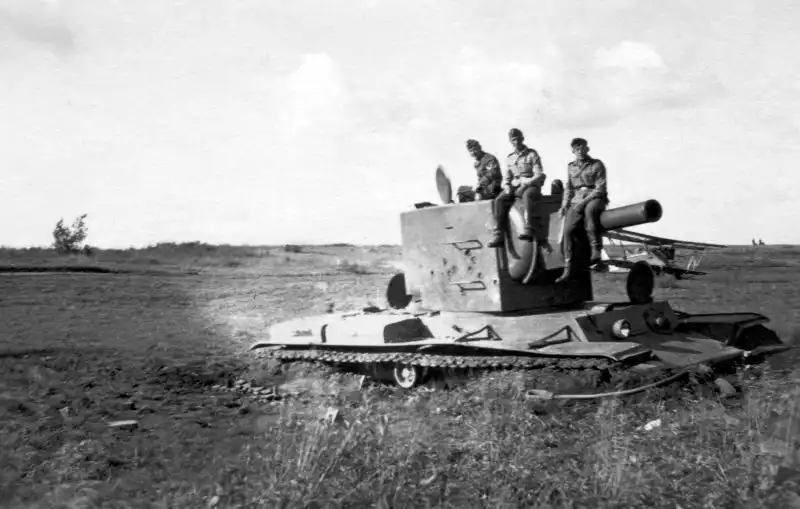
This wartime photograph shows a Kliment Voroshilov (KV-2) heavy breakthrough tank immobilized in a flooded meadow after intense fighting during the summer of 1941. Unable to free the 52-ton vehicle from the mud, its crew was forced to abandon it before advancing German troops captured the tank. The turret bears at least eleven visible shell impacts, yet none appears to have penetrated the heavy armor, illustrating the remarkable protection provided by the KV-2. Behind the vehicle lies the wreckage of a destroyed Soviet aircraft, believed to be a Polikarpov R-5 reconnaissance biplane.
The tank is widely believed to have been vehicle B-4712 of the 1st Tank Battalion, 28th Tank Regiment, 14th Tank Division, 7th Mechanized Corps of the Western Front. After undergoing engine repairs near Smolensk, it was rushed back into action during the defense of Vitebsk in early July 1941. According to surviving accounts, the crew successfully blocked German attempts to seize a railway bridge, reportedly destroying eight enemy tanks while expending two complete ammunition loads.
After the engagement, the KV-2 headed to replenish its fuel supply but was unexpectedly committed to another battle before ammunition could be replaced. Despite having little or no ammunition remaining for its main gun, the crew continued fighting and reportedly disabled two German tanks and an artillery piece. During the action, the vehicle sustained severe damage, including punctured radiators, damage to the driver's vision equipment, and a penetration of the turret armor. Lieutenant Klimychev and Junior Sergeant Klimov were killed in the fighting.
While attempting to withdraw, the damaged tank became hopelessly stuck in waterlogged ground. With no recovery vehicles available and German forces closing in, the crew had no choice but to abandon it. Two loaders disappeared after leaving the vehicle, while the surviving crew members eventually managed to return to Soviet lines.
The story of KV-2 B-4712 demonstrates both the strengths and weaknesses of Soviet heavy armor during the opening months of Operation Barbarossa. Its armor repeatedly withstood direct hits that would have destroyed many contemporary tanks, yet even such a formidable machine could be rendered helpless by mechanical damage, exhausted supplies, and impassable terrain. During the chaotic summer campaign of 1941, many Soviet heavy tanks were ultimately lost not because they were outmatched in combat, but because they could no longer be recovered once immobilized.
Today this photograph serves as a striking reminder that the Eastern Front was fought not only against enemy armies but also against unforgiving roads, mud, logistical shortages, and the relentless pace of mechanized warfare.
Technical Photo Data:
📍 Location: Near Vitebsk, Belorussian SSR, USSR (probable)
📅 Date: Summer 1941
📝 Subject: Kliment Voroshilov KV-2 heavy breakthrough tank, believed to be vehicle B-4712 of the 14th Tank Division, abandoned after becoming bogged down following combat
📷 Photographer: Unknown
Historical Background
The KV-2 was developed as a heavy breakthrough tank intended to destroy bunkers, fortified positions, and other heavily defended objectives. Armed with a powerful 152 mm M-10 howitzer and protected by exceptionally thick armor, it shocked German troops during the opening phase of Operation Barbarossa. However, the enormous turret, high weight, and mechanically demanding transmission often limited the vehicle's mobility and reliability. In the fast-moving battles of 1941, heavy tanks like the KV-2 frequently became isolated, and many were abandoned after suffering mechanical failures or becoming trapped in difficult terrain rather than being destroyed outright by enemy fire.
Recommended Reading
- Mikhail Svirin – Stalin's Steel Fist: History of the KV Heavy Tank
- Steven J. Zaloga – Soviet Tanks and Combat Vehicles of World War Two
- David M. Glantz – Barbarossa Derailed
- Robert Forczyk – Tank Warfare on the Eastern Front 1941–1942