Kliment Voroshilov KV-2 heavy breakthrough tank B-4754 disabled during the Battle of Ostrov, Pskov region, July 1941.
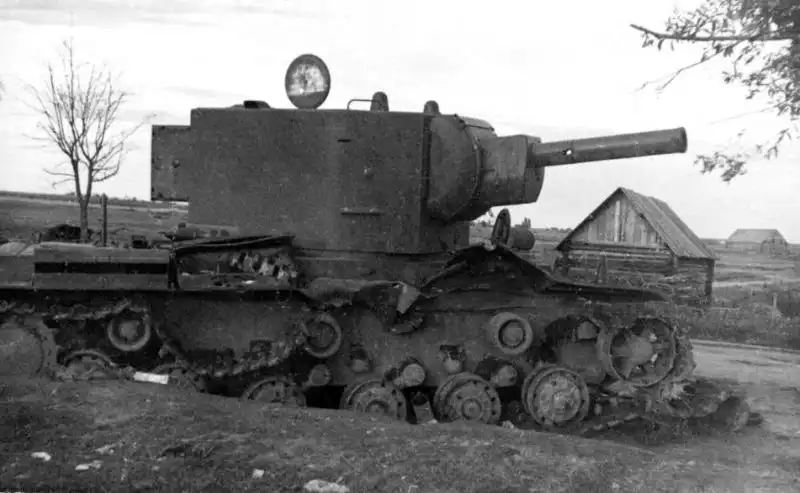
This wartime photograph shows Kliment Voroshilov KV-2 heavy breakthrough tank B-4754 of the 6th Tank Regiment, 3rd Tank Division, 1st Mechanized Corps, disabled during the fighting for the town of Ostrov in the Pskov region on 5 July 1941. The massive vehicle became immobilized while defending a bridge during the opening phase of Operation Barbarossa, one of the most difficult periods faced by the Red Army.
Examination of the damaged tank revealed that its track had been broken, the transmission compartment had been pierced, and the steering mechanism together with the side clutches had been severely damaged. Immobilized in a position that blocked the bridge, the 52-ton vehicle could neither be recovered nor towed away before German forces captured the area.
According to surviving Soviet records, the tank commander, Captain Ivan Ivanovich Rusanov, remained with the disabled vehicle in an attempt to prevent it from falling intact into enemy hands. His ultimate fate remains unknown. The remaining crew members—driver Zhivoglyadov, gun commander Osipov, radio operator Volchkov, and loader Khantsevich—managed to escape and later rejoined their unit.
The KV-2 was originally designed as a heavy breakthrough tank, armed with a formidable 152 mm M-10 howitzer intended to destroy bunkers, fortified positions, and other heavily defended targets. Its thick armor made it one of the most intimidating armored vehicles encountered by German troops during the first weeks of the invasion. Nevertheless, its enormous weight, tall silhouette, and complex mechanical systems also made it difficult to operate during the fast-moving mobile warfare that characterized the summer campaign of 1941.
The fate of B-4754 illustrates a broader reality of the Eastern Front. During the opening weeks of Operation Barbarossa, many Soviet heavy tanks were not destroyed solely by enemy gunfire. Mechanical failures, damaged running gear, fuel shortages, and the inability to recover disabled vehicles often proved just as fatal as direct combat. Once immobilized, even the most heavily armored machines frequently had to be abandoned as the front shifted rapidly.
Today this photograph stands as both a technical record of one particular KV-2 and a reminder of the determination of its crew. It reflects the chaotic conditions of the first weeks of the German invasion, when Soviet tankers continued fighting despite overwhelming operational difficulties and rapidly changing battlefield conditions.
Technical Photo Data:
📍 Location: Ostrov, Pskov Oblast, USSR
📅 Date: 5 July 1941
📝 Subject: Kliment Voroshilov KV-2 heavy breakthrough tank B-4754 of the 6th Tank Regiment, disabled during the Battle of Ostrov
📷 Photographer: Unknown
Historical Background
The KV-2 was developed from the KV-1 heavy tank to provide direct fire support against fortified defensive positions. Its enormous turret housed a 152 mm howitzer capable of demolishing bunkers and reinforced structures that ordinary tank guns struggled to destroy. Although exceptionally powerful, the design suffered from a high center of gravity, slow turret traverse, and frequent mechanical problems. During Operation Barbarossa, these weaknesses became increasingly apparent as Soviet heavy tanks were forced into fast-moving defensive battles for which they had never been intended. Even so, the appearance of KV tanks frequently shocked German troops, whose standard anti-tank weapons often proved ineffective against their thick armor.
Recommended Reading
- Mikhail Svirin — Stalin's Steel Fist: History of the KV Heavy Tank
- Steven J. Zaloga & James Grandsen — Soviet Tanks and Combat Vehicles of World War Two
- David M. Glantz — Barbarossa Derailed
- Robert Forczyk — Tank Warfare on the Eastern Front 1941–1942