Panzerkampfwagen V "Panther" (Pz.Kpfw. V) tank turret repurposed as a fortified pillbox (Pantherturm) during the defense of Berlin, May 1945.
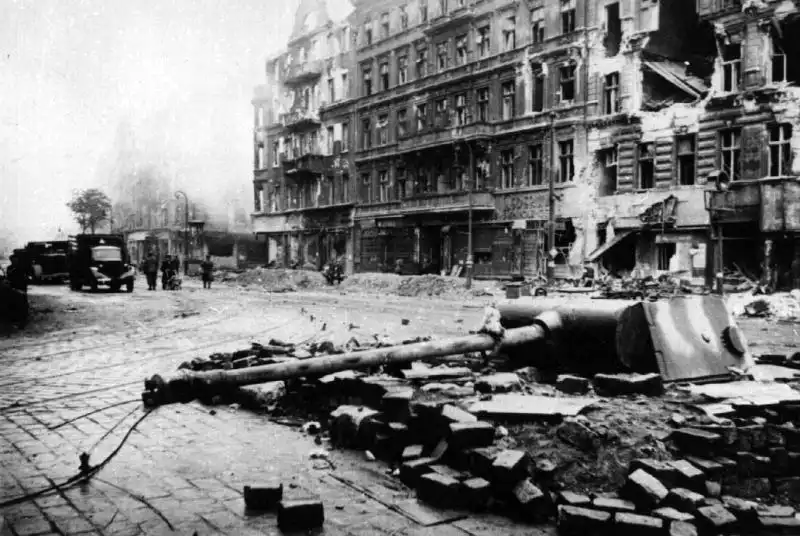
This photograph shows the turret of a German Panzerkampfwagen V "Panther" (Pz.Kpfw. V) converted into a fortified defensive position, commonly known as a Pantherturm, during the Battle of Berlin in May 1945. Installed at street level, the turret served as a fixed strongpoint intended to slow the advancing Red Army during the final defense of the German capital.
Beginning in 1943, Germany increasingly adapted Panther turrets for permanent defensive installations. Some turrets came from damaged or obsolete tanks, while many others were manufactured specifically for static fortifications. Unlike standard tank turrets, purpose-built Pantherturm models usually omitted the commander's cupola, replacing it with a simpler hatch, and featured reinforced roof armor capable of resisting much heavier artillery fire.
The completed fortifications were installed on either prefabricated steel structures, known as Pantherturm I, or reinforced concrete bunkers designated Pantherturm III. These compact strongpoints combined the firepower of the Panther's powerful 75 mm KwK 42 L/70 gun with the protection of a fixed defensive position, making them formidable obstacles against attacking armor and infantry.
Panthertürme were deployed along sections of the Atlantic Wall, the Eastern Front, and within several German Festungen ("fortress cities"), including Berlin. During the final battles of 1945 they became part of an improvised urban defense system that relied on barricades, anti-tank obstacles, and isolated strongpoints rather than continuous defensive lines.
Despite their impressive protection and firepower, these fortifications had significant limitations. Once identified, they could often be isolated, bypassed, or destroyed by heavy artillery, engineers, or coordinated infantry assaults. In the dense streets of Berlin, many Panthertürme fought stubbornly but were ultimately overwhelmed as Soviet forces advanced block by block through the city.
This photograph illustrates both German engineering ingenuity and the increasingly desperate measures adopted during the Third Reich's final weeks. Designed to maximize the combat value of available equipment, Panthertürme became symbols of a defensive strategy that sought to compensate for dwindling manpower and armored reserves with heavily fortified firing positions.
Technical Photo Data:
📍 Location: Berlin, Germany
📅 Date: May 1945
📝 Subject: Panzerkampfwagen V "Panther" (Pz.Kpfw. V) turret installed as a Pantherturm fortified pillbox during the Battle of Berlin
📷 Photographer: Unknown
Historical Background
The Pantherturm program reflected Germany's growing reliance on static defenses as the strategic situation deteriorated. Instead of allowing damaged tanks or surplus turrets to remain unused, German engineers incorporated them into permanent fortifications that required fewer personnel while retaining the powerful armament of the Panther. Although these installations never changed the course of the war, they proved dangerous defensive positions that frequently forced Allied troops to employ artillery, explosives, or flanking tactics rather than direct frontal attacks.
Recommended Reading
- Thomas L. Jentz — Germany's Panther Tank: The Quest for Combat Supremacy
- Walter J. Spielberger — Panther & Its Variants
- Antony Beevor — Berlin: The Downfall 1945
- Steven J. Zaloga — Armored Champion: The Top Tanks of World War II
See also
- Panther tanks after World War II
- German fortress city defenses
- Urban combat during the Battle of Berlin
- The fall of Berlin in May 1945
- German armored fortifications of World War II