A dead German soldier and his horse on the street in Königsberg after the Red Army captured the city, April 1945.
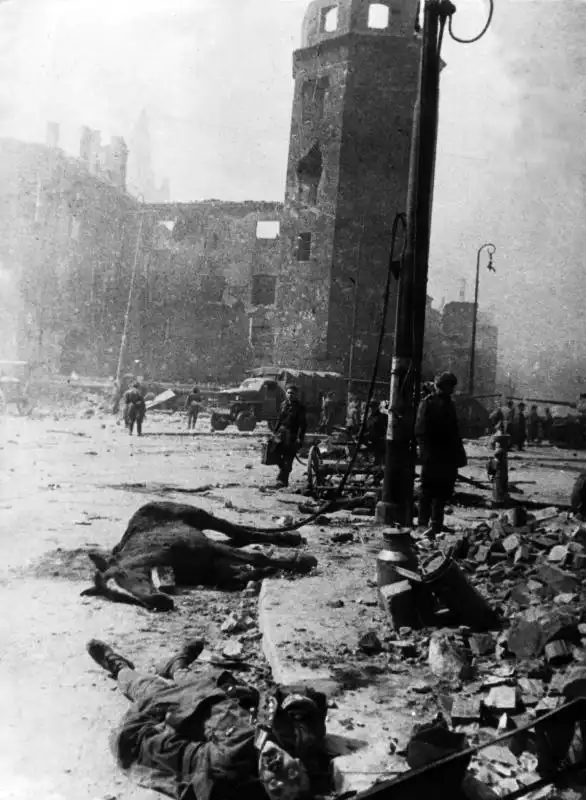
This powerful World War II photograph was taken in Königsberg, the capital of East Prussia, shortly after its capture by the Red Army. Following four days of fierce fighting between 6 and 9 April 1945, one of Nazi Germany's strongest fortified cities finally surrendered. The image, photographed on 10 April 1945 by Emmanuil Evzerikhin, captures the immediate aftermath of the battle before the devastated streets had been cleared.
In the foreground lie the bodies of a German soldier and his horse. The scene is a sobering reminder that horses remained an integral part of military logistics throughout the Second World War. Despite the popular image of fully mechanized armies, both the Wehrmacht and the Red Army relied on hundreds of thousands of horses to transport ammunition, artillery, food, medical supplies, and engineering equipment. In many situations, animals could reach areas inaccessible to trucks or tracked vehicles.
The Battle of Königsberg was one of the last major urban assaults on the Eastern Front. Soviet forces attacked the city with overwhelming artillery, heavy tanks, self-propelled guns, and extensive air support. German defenders fought from a network of forts, bunkers, and barricaded streets, but the isolated garrison could no longer expect relief as the Third Reich collapsed on every front.
The destruction visible throughout the city reflected months of bombing and days of intense street fighting. Buildings were shattered, roads blocked with rubble, and military equipment littered the streets. Countless civilians also suffered during the siege, making Königsberg one of many European cities devastated during the final months of the war.
Following Germany's surrender, northern East Prussia became part of the Soviet Union. Königsberg was renamed Kaliningrad in 1946 and gradually rebuilt, while many surviving German structures disappeared during the post-war reconstruction. Today, wartime photographs such as this provide invaluable historical evidence of the scale of destruction that accompanied the final Soviet offensives.
Beyond its military significance, the image also conveys the universal tragedy of war. The fallen soldier and his horse, lying together on the silent street, symbolize the enormous human and animal losses suffered by all sides during the conflict, reminding viewers that victory and defeat alike came at an immense cost.
Technical photo data:
📍 Location: Königsberg, East Prussia, Germany (now Kaliningrad, Russia)
📅 Date: 10 April 1945
📝 Event: Aftermath of the Battle of Königsberg following the Soviet capture of the city
📷 Author: Emmanuil Evzerikhin
Recommended literature:
- Richard Overy — Russia's War
- David M. Glantz — When Titans Clashed: How the Red Army Stopped Hitler
- Earl F. Ziemke — The Battle for Berlin: End of the Third Reich
- Antony Beevor — Berlin: The Downfall 1945
- Fall of Königsberg 1945
- Red Army East Prussia offensive
- Urban combat WWII Germany
- Königsberg ruins WWII
- WWII photography Eastern Front