Captured German Panzerkampfwagen III (Pz.Kpfw. III) Ausf. J medium tank in service with the Soviet 107th Separate Tank Battalion, Volkhov Front, 6 July 1942.
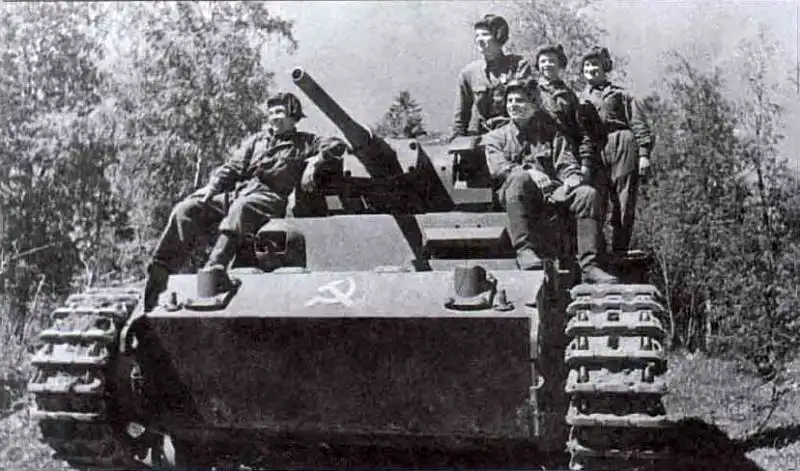
This wartime photograph shows a captured German Panzerkampfwagen III (Pz.Kpfw. III) Ausf. J medium tank that had been pressed into Red Army service with the 107th Separate Tank Battalion. Commanded by Senior Lieutenant N. I. Baryshev, the vehicle was photographed on 6 July 1942 during operations on the Volkhov Front, one of the most fiercely contested sectors in the struggle to break the Siege of Leningrad.
Originally built for the Wehrmacht, the tank had been captured during earlier fighting, repaired, repainted with Soviet markings, and returned to combat. Throughout 1942, the Red Army increasingly relied on serviceable German armored vehicles whenever shortages of domestic tanks made every combat-ready machine valuable. Captured equipment was carefully inspected, repaired, and adapted for Soviet use whenever possible.
The Panzerkampfwagen III Ausf. J represented one of the most capable versions of the Panzer III family then in widespread German service. Armed with the long-barreled 50 mm KwK 39 L/60 gun and fitted with improved frontal armor, it was a considerable improvement over earlier variants. Nevertheless, like many German medium tanks of 1942, it still faced increasing difficulty when confronting well-armored Soviet vehicles such as the T-34 and KV series under typical battlefield conditions.
The 107th Separate Tank Battalion became one of the best-known Red Army formations equipped with captured German armored vehicles. Rather than treating enemy tanks merely as trophies or intelligence sources, Soviet crews learned to maintain, repair, and operate them in combat. The battalion demonstrated how flexibility, technical skill, and battlefield improvisation could transform captured enemy equipment into valuable combat assets.
This photograph illustrates an often-overlooked aspect of the Eastern Front: the extensive Soviet use of captured German armor. It stands as evidence that wartime success depended not only on industrial production, but also on the ability to recover, adapt, and effectively employ whatever equipment could be brought back into service.
Technical Photo Data:
📍 Location: Volkhov Front, Leningrad Region, USSR
📅 Date: 6 July 1942
📝 Subject: Captured German Panzerkampfwagen III (Pz.Kpfw. III) Ausf. J in service with the Soviet 107th Separate Tank Battalion under Senior Lieutenant N. I. Baryshev
📷 Photographer: Unknown
Historical Background
Captured German armored vehicles became an important supplement to Soviet armored forces during the difficult years of 1942–1943. Specialized repair facilities restored damaged tanks, replaced missing components where possible, and repainted the vehicles with Soviet tactical markings to reduce the risk of friendly fire. Although shortages of spare parts and ammunition limited their long-term usefulness, these tanks provided valuable reinforcements until Soviet industry could fully replace early-war losses. The experience gained by units such as the 107th Separate Tank Battalion also influenced later Soviet programs involving captured armored vehicles, including the conversion of German chassis into self-propelled guns.
Recommended Reading
- Steven J. Zaloga — Armored Champion: The Top Tanks of World War II
- Mikhail Baryatinskiy — Captured Tanks Under the Red Banner
- David Glantz — The Battle for Leningrad 1941–1944
- Thomas L. Jentz — Panzer Tracts No. 3: Panzerkampfwagen III