Propaganda portrait of a decorated German Feldwebel on the Eastern Front during World War II.
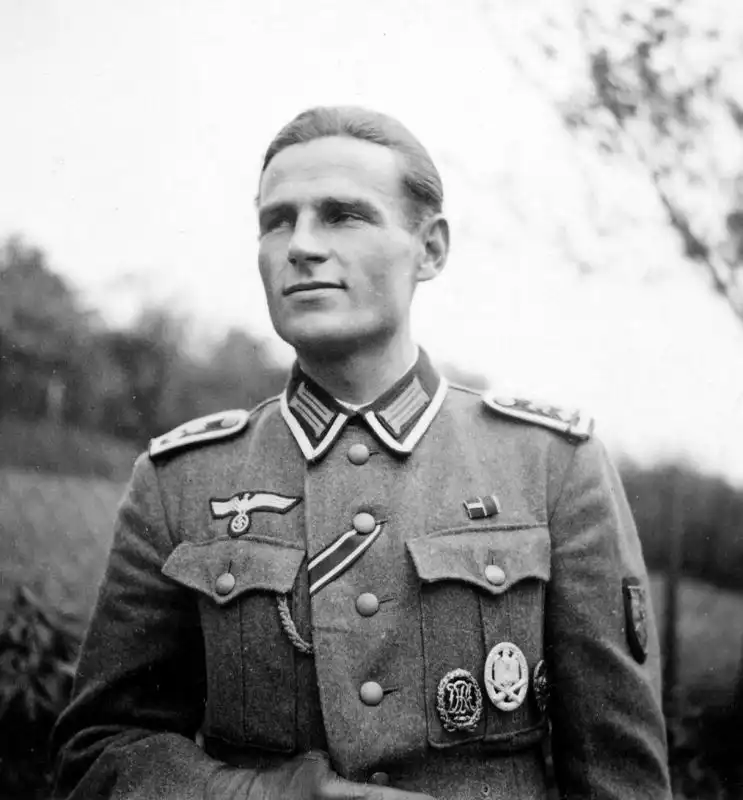
This striking portrait presents a German Feldwebel (sergeant) in a carefully composed image typical of wartime propaganda produced by the Third Reich. Every visible detail—from the soldier's posture and facial expression to the prominent display of decorations—was intended to project confidence, discipline, experience, and unwavering determination. Rather than documenting combat, the photograph was designed to shape public perception of the "ideal" German fighting man.
One of the most recognizable decorations is the Crimea Shield (Krimschild), worn on the lower left sleeve. Instituted in 1942, it was awarded to members of the Wehrmacht and Luftwaffe who participated in the Crimean campaign, including the prolonged siege and capture of Sevastopol. Campaign shields such as this became highly visible symbols of service on some of Germany's most fiercely contested fronts.
Several additional awards can be identified on the tunic. The German Sports Badge (Deutsches Reichssportabzeichen, DRA) reflects pre-war physical training and athletic achievement, qualities heavily promoted by the Nazi state as essential characteristics of military service. More significant from a combat perspective is the General Assault Badge (Allgemeines Sturmabzeichen), presented to soldiers who took part in repeated assaults, counterattacks, or other frontline combat actions but did not qualify for the Infantry Assault Badge because of their branch of service.
Although the decorations represent genuine military qualifications, the photograph itself is clearly intended as a propaganda image rather than a spontaneous portrait from the front. Wartime photographers frequently emphasized medals, insignia, and confident expressions to create powerful visual narratives that boosted morale at home and reinforced the image of a disciplined and victorious army. Such portraits appeared in newspapers, magazines, recruiting material, and official publications throughout the war.
Today, photographs like this are valuable not because they celebrate the individual depicted, but because they reveal how visual propaganda functioned. They remind us that wartime photography often served two purposes simultaneously: documenting real soldiers while carefully constructing the public image that governments wanted their societies—and their enemies—to see.
Technical Photo Data:
📍 Location: Eastern Front (exact location unknown)
📅 Date: World War II (exact date unknown)
📝 Subject: Decorated German Feldwebel wearing the Crimea Shield, General Assault Badge, and German Sports Badge in a posed propaganda portrait
📷 Photographer: Unknown
Historical Background
Portrait photography occupied an important place in German wartime propaganda. Official photographers and military publications sought to present soldiers as disciplined, physically fit, and decorated veterans whose appearance embodied military professionalism. Awards and insignia were deliberately highlighted because they conveyed authority and battlefield experience at a glance. While many such portraits depicted genuine combat veterans, their composition was carefully controlled to support the broader propaganda narrative promoted by the Nazi regime.
Recommended Reading
- Angolia, John R. – For Führer and Fatherland: Military Awards of the Third Reich
- Brian L. Davis – German Army Uniforms and Insignia 1933–1945
- David Welch – The Third Reich: Politics and Propaganda
- Nicholas O'Shaughnessy – Selling Hitler: Propaganda and the Nazi Brand