Michael Wittmann, one of the most famous German Tiger I tank commanders of World War II, photographed in France in 1944.
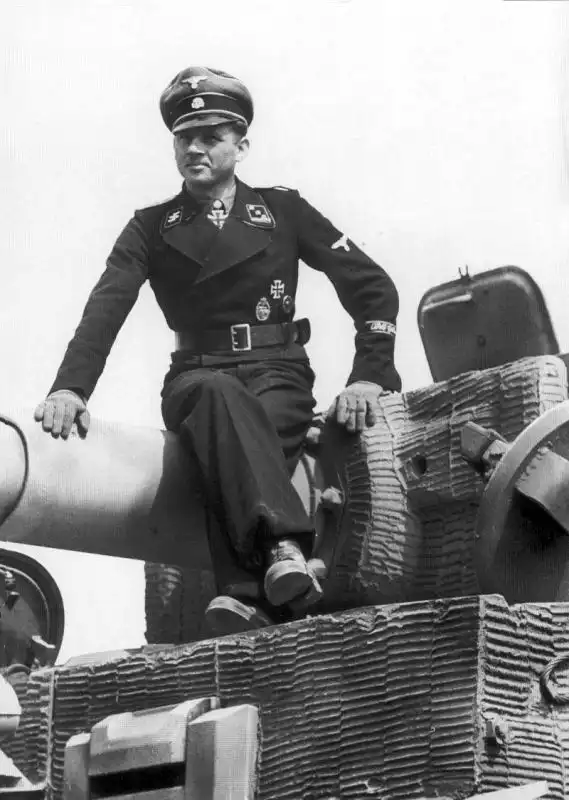
One of the best-known Tiger commanders
This photograph shows Michael Wittmann (1914–1944), one of the most widely recognized German tank commanders of the Second World War. Seated on the armor of his Tiger I, Wittmann became one of the most celebrated figures of the German Panzerwaffe through a combination of battlefield success and extensive wartime propaganda.
He first gained widespread attention during the Battle of Kursk in July 1943. According to German military records, Wittmann destroyed numerous Soviet tanks and anti-tank guns during the opening days of the offensive, earning high military decorations and a reputation as one of Germany's most effective heavy tank commanders.
The battle at Villers-Bocage
Wittmann's most famous action took place on 13 June 1944 near the French town of Villers-Bocage. Commanding Tiger No. 007, he launched a surprise attack against elements of the British 7th Armoured Division, widely known as the "Desert Rats." Within a short time, several British tanks and other military vehicles were destroyed, temporarily disrupting the Allied advance. The exact number of vehicles destroyed remains the subject of historical debate, but the engagement became one of the best-known tank actions of the Normandy campaign.
The end of his career
By the summer of 1944, official German records credited Wittmann with the destruction of more than one hundred enemy tanks and numerous artillery pieces. On 8 August 1944, during fighting near Saint-Aignan-de-Cramesnil in Normandy, his Tiger was knocked out and destroyed. Most historians believe the fatal shot was fired by a British Sherman Firefly, although the exact circumstances have remained a topic of discussion for decades. None of the crew survived.
Michael Wittmann remains one of the most studied and controversial armored commanders of World War II. Admired by German wartime propaganda for his battlefield achievements, he is also remembered as a participant in one of history's most destructive conflicts, where tactical skill and personal courage were inseparable from the broader tragedy of war.
Photo details
Location: France
Date: 1944
Photographer: Unknown German war correspondent
Historical background
Although Michael Wittmann became one of the best-known tank commanders of the war, historians continue to debate many aspects of his combat record, particularly the exact number of vehicles destroyed at Villers-Bocage and the identity of the Allied unit that ultimately knocked out his Tiger. Regardless of these debates, his name remains closely associated with the Tiger I heavy tank and German armored operations in both the Soviet Union and Normandy.
Sources
- German wartime military records.
- Research on the Battle of Villers-Bocage and the Normandy campaign.
- Studies of German armored forces during World War II.
Recommended reading
- Michael Wittmann and the Tiger I.
- The Battle of Villers-Bocage.
- Early combat service of the Tiger I.
- Tiger I tanks during the Normandy campaign.
- Tank battles on the Eastern Front.