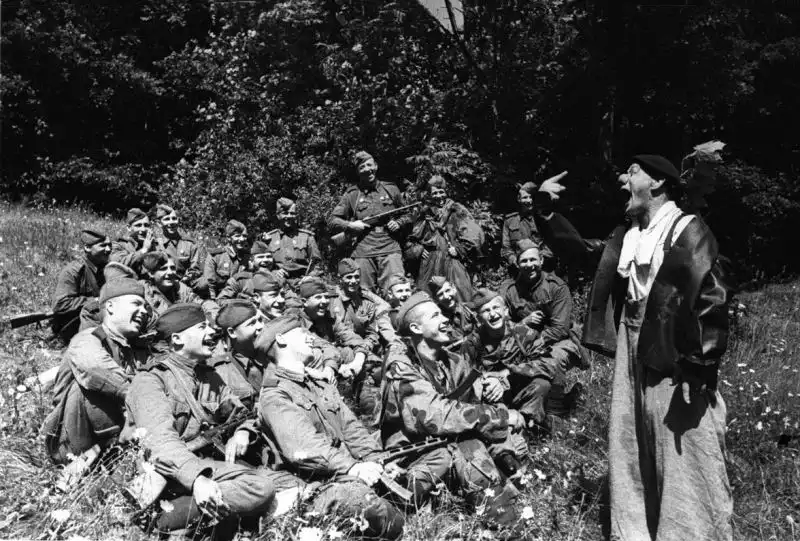
Red Army scout and former circus acrobat Fyodor Suvorov performing for Soviet troops on the Eastern Front, 1943.
When a Scout Became a Clown
This remarkable wartime photograph captures one of the rare moments when laughter briefly replaced gunfire on the Eastern Front. Senior Sergeant Fyodor Ignatievich Suvorov, a Red Army reconnaissance soldier and former circus artist, performs for his comrades during a pause in combat operations in 1943. The image reminds us that maintaining morale was nearly as important as supplying ammunition, especially in frontline reconnaissance units constantly exposed to danger.
Before the war, Suvorov graduated from one of the Soviet Union's early circus schools and performed in the popular acrobatic act known as the "Barrel Jumpers". His circus training unexpectedly became valuable military experience. Balance, agility, physical endurance, and the ability to improvise under pressure proved useful qualities for a reconnaissance soldier operating behind enemy lines.
Serving with the 50th Tank Brigade, Suvorov distinguished himself during combat missions and received the medals "For Courage", "For Military Merit", and the Order of the Red Star. After being wounded in June 1943, he was no longer able to serve in frontline reconnaissance and was transferred to cultural work within the 3rd Tank Corps. There he organized performances, managed the soldiers' club, and continued supporting the fighting spirit of Red Army personnel. His contribution was recognized with another Order of the Red Star and the Order of the Patriotic War, 2nd Class.
During these improvised concerts, Suvorov often appeared as a clown with bright red hair, oversized homemade trousers, and a comic nose fashioned from bandages and cotton. Such performances may seem unusual today, but they played an important role during the war. Frontline concerts, amateur performances, and brief moments of humor helped exhausted soldiers recover emotionally before returning to combat.
The photograph also contains several details of military interest. In the front row, two soldiers wear the distinctive MKK camouflage suit, commonly known as the "Amoeba" camouflage pattern. Introduced before the war, this camouflage was widely issued to reconnaissance troops, snipers, and other soldiers whose duties required concealment in the field.
Rather than depicting battle itself, this image preserves something equally valuable—the human side of war. Even amid one of history's most brutal conflicts, soldiers still found time to laugh, applaud a performance, and briefly forget the dangers waiting just beyond the front line.
Technical Photo Data
📍 Location: USSR
📅 Date: 1943
📝 Subject: Senior Sergeant Fyodor Ignatievich Suvorov, Red Army scout and former circus performer, entertaining Soviet troops during a frontline concert
📷 Photographer: Natalia Bode
Historical Significance
Photographs of frontline entertainment are considerably less common than images of combat. They illustrate how the Red Army combined military operations with organized cultural activities intended to maintain morale, strengthen unit cohesion, and provide psychological relief after prolonged periods of fighting. Suvorov's biography also demonstrates how civilian skills acquired before the war could find unexpected value both in combat service and in supporting fellow soldiers.
Recommended Reading
- David M. Glantz — When Titans Clashed: How the Red Army Stopped Hitler
- Catherine Merridale — Ivan's War: Life and Death in the Red Army
- Roger R. Reese — Why Stalin's Soldiers Fought
- Artem Drabkin — I Fought in a Tank