German Panzer III Ausf. J tanks advancing through snow on the Eastern Front, winter 1941–1942.
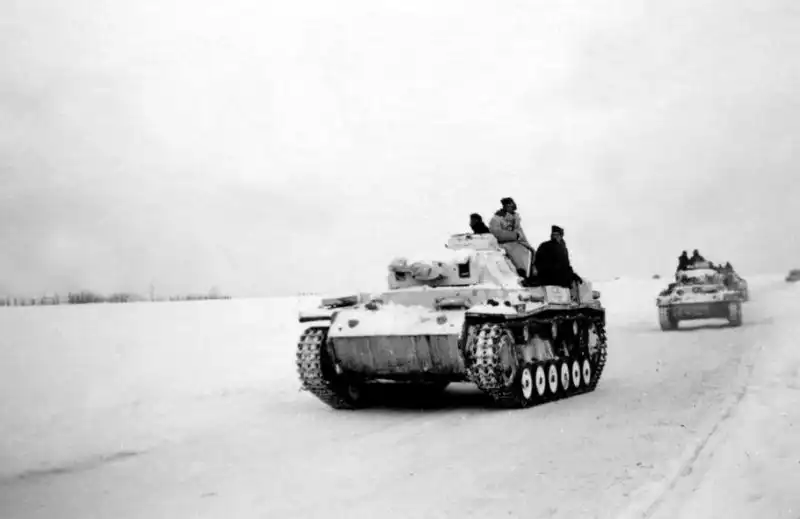
This World War II photograph shows a column of German Panzer III Ausf. J medium tanks advancing across a snow-covered road during the harsh winter of 1941–1942. At this stage of the Eastern Front campaign, the Panzer III remained one of the principal battle tanks of the Wehrmacht and formed the backbone of many German armored divisions operating deep inside Soviet territory.
The Panzer III Ausf. J was armed with the 5 cm KwK 38 L/42 gun and represented the peak of the original Panzer III design before heavier Soviet tanks forced further upgrades. German doctrine emphasized close coordination between tanks, infantry, artillery, engineers, and aircraft, supported by reliable radio communications in nearly every vehicle. During the opening months of Operation Barbarossa, this combination allowed German armored formations to achieve a series of rapid operational successes.
Winter, however, exposed weaknesses that planning had underestimated. Temperatures far below freezing caused engines to become difficult to start, lubricants to thicken, batteries to lose efficiency, and mechanical components to wear more quickly. Snow-covered roads, muddy tracks, and long supply lines complicated fuel deliveries and maintenance, reducing the operational effectiveness of even well-trained armored units.
The designation "5 cm" also illustrates a characteristic feature of German military nomenclature. Unlike the Soviet Union, which usually expressed artillery calibers in millimeters, or Britain and the United States, where many weapons were identified by inches, Germany commonly designated artillery pieces and tank guns in centimeters. Thus, the Panzer III's 5 cm KwK 38 was in fact a 50 mm tank gun, while famous weapons such as the 8.8 cm Flak corresponded to an 88 mm caliber.
This image captures a turning point in the war. The armored columns that had advanced rapidly across the Soviet Union during the summer now faced not only determined resistance but also one of the harshest winters in modern military history. The photograph illustrates how climate, logistics, and industrial endurance became just as decisive as armor thickness or gun caliber in determining the outcome of the Eastern Front.
Technical Photo Data:
📍 Location: USSR
📅 Date: Winter 1941–1942
📝 Subject: German Panzer III Ausf. J tanks during winter operations on the Eastern Front
📷 Photographer: Unknown
Recommended literature:
- Thomas L. Jentz — Panzer Tracts No. 3-3: Panzerkampfwagen III Ausf. J, L, M und N.
- Steven J. Zaloga — Panzer III vs T-34: Eastern Front 1941.
- Karl-Heinz Frieser — The Blitzkrieg Legend: The 1940 Campaign in the West (background on German armored doctrine).
- David M. Glantz — When Titans Clashed: How the Red Army Stopped Hitler.
- German tanks on the Eastern Front
- Panzer III Ausf. J history
- 5 cm KwK 38 tank gun
- Wehrmacht armored divisions
- Operation Barbarossa winter campaign