German Tiger I heavy tank with its crew on the Western Front, 1944.
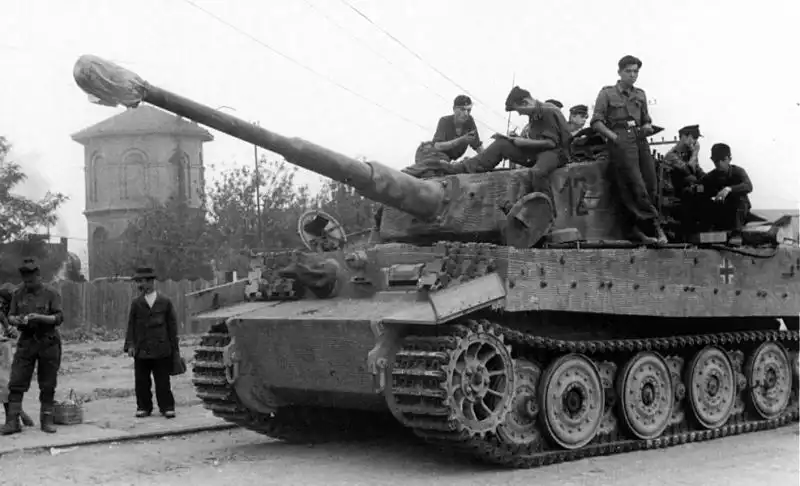
This World War II photograph shows a German Panzerkampfwagen VI Tiger I heavy tank and its crew on the Western Front in 1944. The tankers are seated on the armored hull of their vehicle, a common sight during short pauses in combat operations when crews rested beside the machines that had become both their weapon and their shelter. The worn appearance of the vehicle, including damaged or missing track fenders, reflects the harsh conditions of prolonged frontline service.
Introduced into service in 1942, the Tiger I quickly became one of the most famous and feared German tanks of the Second World War. Its combination of heavy armor, powerful 88 mm KwK 36 L/56 gun, and excellent optics gave it a significant advantage in many tank engagements. Against many Allied tanks of the early and middle war period, the Tiger could engage opponents at distances where return fire was often ineffective.
By 1944, Tiger I tanks were fighting on both the Eastern and Western Fronts, usually serving in heavy tank battalions that were deployed where German commanders needed additional firepower. On the Western Front, after the Allied landings in Normandy, these units were frequently used as mobile reserves, rushing to threatened sectors and attempting to stop Allied advances through counterattacks and defensive operations.
However, the impressive battlefield reputation of the Tiger I concealed serious limitations. The tank was extremely expensive and complicated to manufacture, required large amounts of fuel, and placed heavy demands on maintenance crews. Its enormous weight created difficulties on bridges, roads, and muddy terrain, while mechanical failures could leave even a powerful Tiger abandoned on the battlefield. In a war increasingly dominated by mass production, air superiority, and logistics, a handful of technically superior tanks could not compensate for Germany’s growing strategic disadvantages.
For Allied and Soviet soldiers, encountering a Tiger often meant facing one of the most dangerous armored opponents of the war. Yet for German crews, the Tiger was not an invincible machine, but a demanding weapon that required skill, experience, and constant technical support. The men photographed here were part of a generation of tankers who fought in some of the most intense armored battles of the final years of World War II.
This image remains a valuable historical document of German armored warfare in 1944. Beyond the famous silhouette of the Tiger I tank, it shows the human element behind the machine—the crews who lived with these vehicles, maintained them under difficult conditions, and operated them during the final stages of the war in Europe.
Technical photo data:
📝 Source of information: German wartime archives
📍 Location: Western Front, Europe
📅 Date: 1944
📷 Photographer: Unknown German war photographer
- Tiger I heavy tank Western Front WWII
- German PzKpfw VI Tiger tank crew photo
- Wehrmacht armored forces on the Western Front 1944
- Tiger I combat history against Allied and Soviet tanks
- German armored divisions in World War II
- Tiger I tank battlefield history
- Early Tiger I deployment history
- Tiger tank mechanical problems and battlefield limitations
- German heavy tank operations in France 1944
- Tiger I iconic armored vehicle photographs WWII