German 15 cm Kanone 16 firing during combat operations on the Eastern Front, summer 1941.
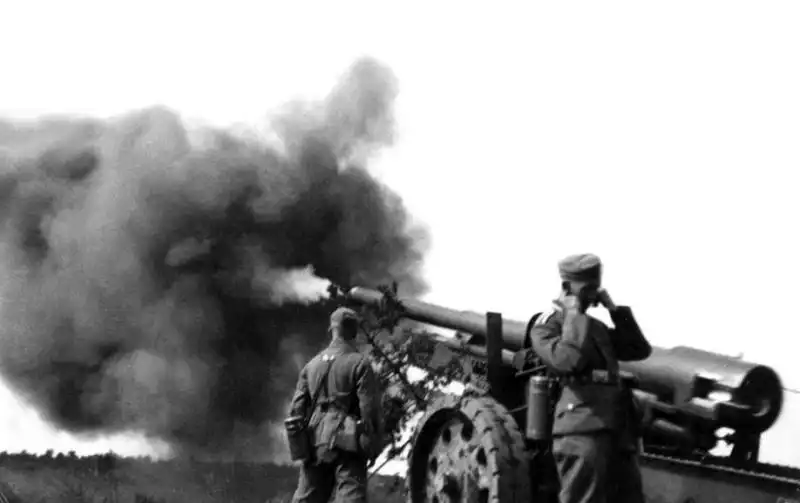
The photograph captures a German 15 cm Kanone 16 (K 16) firing during combat on the Eastern Front in the summer of 1941. A massive cloud of smoke erupts from the barrel as the gun crew supports advancing Wehrmacht formations during the opening weeks of Operation Barbarossa. Although Germany relied heavily on fast-moving armored units, victories in 1941 also depended upon the sustained firepower of heavy artillery capable of striking targets far beyond the front line.
Originally designed during World War I, the 15 cm Kanone 16 remained a valuable long-range weapon throughout the Second World War. The designation "15 cm" reflected the German military's convention of expressing artillery calibers in centimeters rather than millimeters. With an effective range exceeding 20 kilometers, the gun was employed for counter-battery fire, destruction of fortified positions, interdiction of roads and bridges, and bombardment of command posts far behind enemy lines.
During the first months of the invasion of the Soviet Union, German artillery was carefully coordinated with infantry and armored formations. Before assaults began, batteries such as this one attempted to suppress Soviet defensive positions, disrupt communications, and weaken resistance before ground troops advanced. Even in the era of blitzkrieg, heavy guns remained an indispensable component of German operational planning.
At the same time, weapons of this size demanded an enormous logistical effort. The K 16 required powerful prime movers, trained gun crews, large ammunition stocks, and carefully prepared firing positions. As German forces advanced deeper into Soviet territory and supply lines stretched over hundreds of kilometers, maintaining heavy artillery units became increasingly difficult despite their impressive battlefield effectiveness.
This image illustrates both the destructive power and the logistical complexity of twentieth-century warfare. Behind the dramatic muzzle blast stood an extensive network of transport, engineering, communications, and ammunition supply that allowed heavy artillery to influence operations across vast sectors of the Eastern Front.
Technical Photo Data:
📍 Location: USSR
📅 Date: Summer 1941
📝 Subject: German 15 cm Kanone 16 heavy field gun supporting Wehrmacht operations during Operation Barbarossa
📷 Photographer: Unknown