Soviet 45 mm anti-tank gun crew firing at German tanks on the Eastern Front, 1943.
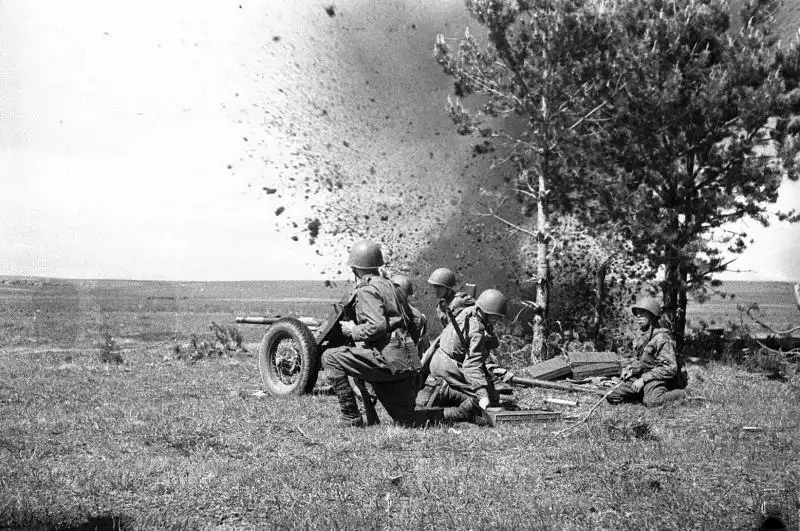
This dramatic wartime photograph captures a Soviet 45 mm M1937 (53-K) anti-tank gun in action during heavy fighting on the Eastern Front in 1943. Commanded by Senior Sergeant A. Golovalov, the crew is shown engaging German armored vehicles at direct-fire range, where every second determined whether the gun or the approaching tank would survive.
According to wartime reports, Golovalov's crew had already destroyed two German tanks and knocked out six enemy firing positions while serving in the battery of Senior Lieutenant A. Medvedev. Such achievements required exceptional discipline and marksmanship, as the 45 mm gun was most effective only at relatively short distances against increasingly well-armored German vehicles.
Known throughout the Red Army simply as the "Sorokapyatka" ("Forty-Five"), the weapon became one of the most recognizable Soviet anti-tank guns of the Second World War. Introduced before the conflict, it combined mobility, a high rate of fire, and sufficient armor penetration against early-war tanks. By 1943, however, heavier German vehicles such as later Panzer IV variants, Panthers, and Tigers had reduced its effectiveness from the front, forcing Soviet crews to aim for side armor, running gear, or other vulnerable points.
The explosion visible on the right side of the photograph illustrates the deadly duel between artillerymen and armored vehicles. Anti-tank gun crews usually operated without meaningful protection, remaining exposed to tank guns, machine-gun fire, artillery fragments, and infantry attacks while trying to reload and fire as quickly as possible.
Despite its growing limitations, the 45 mm gun remained in widespread service because it was reliable, easy to conceal, and available in large numbers. In skilled hands, the "Sorokapyatka" continued to play an important role in Soviet defensive operations and infantry support throughout much of the war.
Technical Photo Data:
📍 Location: USSR
📅 Date: 1943
📷 Photographer: Mikhail Savin
Recommended literature:
- Steven J. Zaloga — Soviet Tanks and Combat Vehicles of World War Two
- David M. Glantz — When Titans Clashed
- Chris McNab — Weapons of the Red Army 1930–1945
- 53-K anti-tank gun history
- Soviet artillery crews in combat
- Eastern Front armored warfare
- 45 mm anti-tank gun "Sorokapyatka"
- Red Army battlefield photography