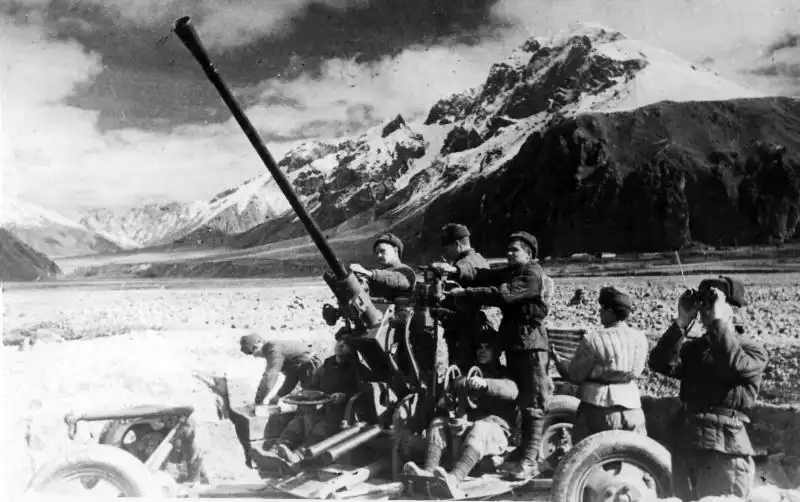
Soviet 37mm 61-K anti-aircraft gun crew led by Sergeant I.I. Shapin near Nalchik, North Caucasus, USSR, 1942.
Soviet Air Defenders in the North Caucasus
This remarkable wartime photograph shows the crew of a Soviet 37 mm 61-K automatic anti-aircraft gun (Model 1939) commanded by Sergeant I.I. Shapin near Nalchik in the North Caucasus during 1942. The men belonged to the 2nd Guards Rifle Division, later awarded the honorary title of the Tamanskaya Division, one of the Red Army's most distinguished infantry formations.
The image captures the crew at full readiness as they scan the skies for approaching Luftwaffe aircraft. Throughout the German offensive into the Caucasus, Soviet anti-aircraft units were forced to remain constantly alert, since enemy bombers and fighter-bombers regularly attacked troop concentrations, supply columns, railway stations, and mountain roads that were essential for Soviet logistics.
The 37 mm 61-K Anti-Aircraft Gun
Introduced in 1939, the 61-K became the standard light anti-aircraft gun of the Red Army. Firing high-explosive shells at a rapid rate, it proved highly effective against low-flying aircraft while also serving as an emergency weapon against lightly armored vehicles and infantry. Its combination of mobility, reliability, and firepower made it one of the Soviet Union's most successful air-defense weapons during the Second World War.
The weapon was particularly valuable in the mountainous terrain of the North Caucasus, where rapidly changing front lines and difficult roads required anti-aircraft units to relocate frequently. Gun crews often established firing positions close to advancing infantry, providing immediate protection against sudden air attacks while remaining ready to move with the frontline.
The Battle for the Caucasus
During the German 1942 summer offensive, control of the Caucasus became a strategic priority because of its vital oil fields and transportation routes. Luftwaffe aircraft attempted to disrupt Soviet defenses and isolate frontline units through continuous bombing missions. Anti-aircraft batteries like Sergeant Shapin's played an essential role in limiting these attacks, protecting soldiers, artillery positions, and supply networks that kept the Red Army fighting.
Photographs such as this emphasize that victory in the air was not achieved solely by fighter pilots. Thousands of Soviet anti-aircraft gunners spent countless hours watching the skies, often under difficult combat conditions, ready to engage enemy aircraft at a moment's notice. Their vigilance formed a critical layer of the Soviet Union's wartime air-defense system.
Technical Photo Data
Location: Near Nalchik, North Caucasus, USSR
Date: 1942
Unit: 2nd Guards Rifle Division (later Tamanskaya Division)
Weapon: 37 mm 61-K automatic anti-aircraft gun (Model 1939)
Photographer: Unknown (Soviet wartime archive)
Historical Significance
The photograph documents the everyday service of Soviet anti-aircraft crews during one of the most critical campaigns of the Eastern Front. It illustrates the importance of mobile air defense in protecting Red Army formations during the Battle of the Caucasus and offers a valuable glimpse into the men who operated one of the Soviet Union's most widely used anti-aircraft guns.
Recommended Literature
- David M. Glantz — The Battle for the Caucasus 1942–1943
- Chris McNab — Soviet Anti-Aircraft Artillery of World War II
- Steven J. Zaloga — Red Army Handbook 1939–1945
- Richard W. Harrison — The Soviet Army's High Commands in War and Peace