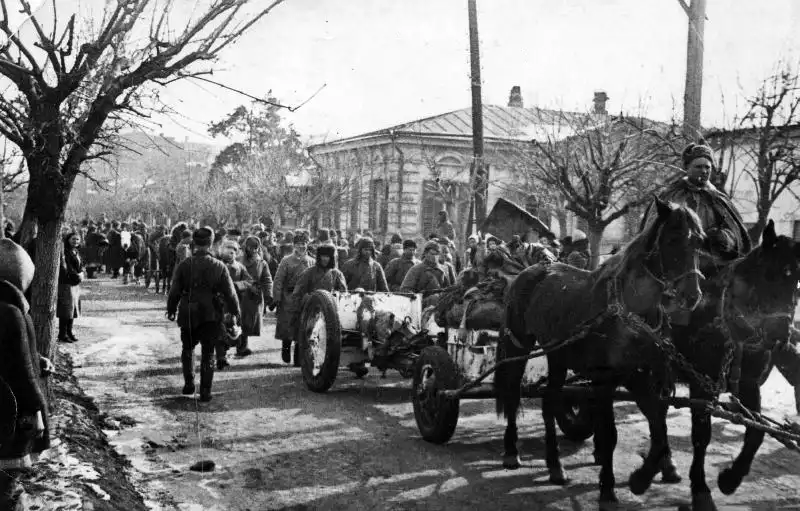
Red Army troops of the 2nd Guards Rifle Division march through liberated Krasnodar, USSR, on February 12, 1943.
The Liberation of Krasnodar
This historic wartime photograph captures soldiers of the 2nd Guards Rifle Division, later awarded the honorary title Tamanskaya Division, marching through the recently liberated city of Krasnodar on February 12, 1943. After months of German occupation, Soviet forces successfully recaptured one of the most important cities in the Kuban region during the North Caucasus Campaign.
The column advances along Sverdlov Street (today Karasunskaya Street) toward the Kuban Embankment, passing the intersection with Oktyabrskaya Street. The photograph reflects not only a military victory but also the return of Soviet authority to a city that had suffered occupation, destruction, and repression.
Horse-Drawn Artillery in a Modern War
Among the marching troops is a battery of 76 mm regimental guns Model 1927, pulled by horse teams. Although World War II is often associated with tanks, aircraft, and mechanized warfare, horses remained indispensable to every major army. The Red Army relied extensively on horse transport to move artillery, ammunition, and supplies across terrain where trucks either could not operate or were unavailable.
The reliable 76 mm regimental gun provided close fire support for advancing infantry. Its relatively light weight allowed crews to reposition it quickly, making it an effective weapon during offensive operations through towns, villages, and difficult countryside.
The North Caucasus Campaign
The liberation of Krasnodar marked a significant turning point in the campaign for the North Caucasus. Following the Soviet victories at Stalingrad, German forces were compelled to withdraw from much of the region, abandoning their ambitions of securing the Caucasus oil fields. The recapture of Krasnodar helped restore Soviet control over critical transportation routes and opened the way for further offensives toward the Kuban and the Taman Peninsula.
For the soldiers marching through the city, the operation represented another step in the long westward advance that would eventually carry the Red Army from the Caucasus to Berlin.
Max Alpert's Historic Photograph
The image was taken by renowned Soviet war photographer Max Alpert, whose work documented many of the defining moments of the Great Patriotic War. Rather than focusing solely on combat, Alpert frequently captured scenes illustrating the determination of Soviet soldiers and the gradual liberation of occupied territories. This photograph combines military history with everyday reality, showing exhausted but victorious troops entering a city beginning its recovery after months of occupation.
Technical Photo Data
Location: Krasnodar, USSR
Date: February 12, 1943
Event: Liberation of Krasnodar during the North Caucasus Campaign
Units: 2nd Guards Rifle Division (later Tamanskaya Division)
Photographer: Max Alpert
Source: Russian State Archive of Film and Photo Documents (RGAKFD)
Historical Significance
This photograph documents one of the key stages of the Soviet winter offensive of 1943. It illustrates the liberation of Krasnodar, the continued importance of horse-drawn artillery in modern warfare, and the resilience of Red Army formations that steadily pushed German forces out of the North Caucasus following the turning point at Stalingrad.
Recommended Literature
- David M. Glantz — From the Don to the Dnieper
- David M. Glantz — The Battle for the Caucasus 1942–1943
- Chris Bellamy — Absolute War: Soviet Russia in the Second World War
- Earl F. Ziemke — Stalingrad to Berlin: The German Defeat in the East