Ruins of Nagasaki After the Atomic Bombing, 1945: A Ground-Level View of a Destroyed City
January 9, 2026 - Reading time: 5 minutes
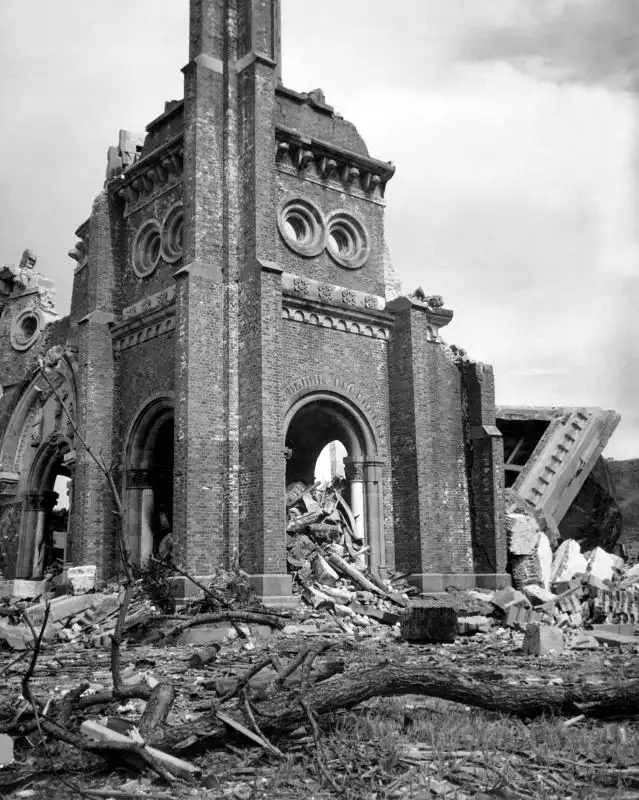
A ground-level view of Nagasaki in August 1945, showing the city reduced to ruins after the atomic bombing, with the remains of the Urakami Cathedral in the background.

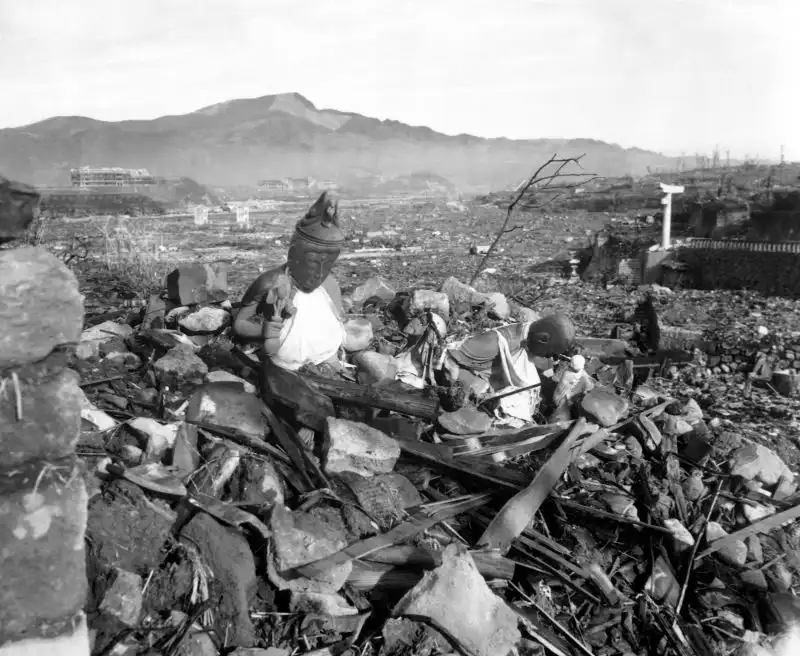
The atomic bombing of Nagasaki on 9 August 1945 marked one of the most dramatic and devastating moments of World War II. This photograph, taken in August 1945, captures a ground-level view of the city reduced almost entirely to rubble. Unlike aerial reconnaissance images, it shows the scale of destruction as experienced on the streets of Nagasaki in the weeks following the explosion.
Nagasaki Before August 1945:
Before the bombing, Nagasaki was a major industrial and port city in southwestern Japan. It housed shipyards, arms factories, and dense residential districts built along narrow valleys between surrounding hills. The city was also home to Japan’s largest Catholic community, centered around the Urakami Cathedral.
Despite its military-industrial importance, large parts of Nagasaki remained civilian neighborhoods, making the city particularly vulnerable to large-scale bombing.
The Atomic Bombing of Nagasaki:
On 9 August 1945, an American B-29 bomber dropped the plutonium-based atomic bomb Fat Man over Nagasaki. The bomb detonated at an altitude of approximately 300 meters above the city.
Key effects of the explosion included:
-
A massive blast wave that flattened buildings across the valley
-
Extreme thermal radiation causing fires and severe burns
-
Widespread structural collapse even at significant distances from the hypocenter
The surrounding hills partially shielded some districts, but areas directly beneath the explosion were almost completely destroyed.
The Ruins and the Urakami Cathedral:
In the background of the photograph, the ruins of the Roman Catholic Urakami Cathedral can be seen on a hillside. Completed in 1925, it was the largest Catholic cathedral in East Asia before the war.
The cathedral stood near the center of the blast zone and was almost entirely destroyed. Its ruins became one of the most recognizable symbols of the devastation of Nagasaki and the impact of atomic warfare on cultural and religious landmarks.
What This Photograph Shows:
This image presents a stark, ground-level perspective of atomic destruction:
-
Entire city blocks reduced to debris
-
Absence of intact civilian infrastructure
-
A landscape reshaped into ruins rather than damaged streets
Such photographs provide historical evidence of how atomic bombing differed fundamentally from conventional air raids, both in scale and in immediacy of destruction.
Historical Significance:
Images like this are essential for understanding:
-
The real physical consequences of strategic bombing in World War II
-
The transformation of warfare through nuclear weapons
-
Postwar discussions on civilian vulnerability and urban destruction
For historians, educators, and readers interested in World War II aviation and strategic bombing, this photograph serves as a crucial visual document.
Photo Information:
📝 Source: wartime photograph
📍 Location: Nagasaki, Japan
📅 Date: August 1945
The ruins of Nagasaki shown in this photograph reflect the unprecedented scale of destruction introduced by nuclear weapons in 1945. Stripped of intact buildings and familiar landmarks, the cityscape stands as a historical record of how World War II ended for millions of civilians far from the front lines.
👉 See also: other historical photographs documenting strategic bombing and military aviation in World War II.
Related Pages



Tags
Category
Search
Categories
- Unidentified WWII Photos (14)
- World War II Photos 1937 (1)
- World War II Photos 1938 (1)
- World War II Photos 1939 (3)
- World War II Photos 1940 (5)
- World War II Photos 1941 (103)
- World War II Photos 1942 (60)
- World War II Photos 1943 (56)
- World War II Photos 1944 (77)
- World War II Photos 1945 (50)
- WWII and Postwar Photos 1946 (1)