Ruins of the Urakami Catholic Cathedral in Nagasaki After the Atomic Bombing
January 5, 2026 - Reading time: 9 minutes
Ruins of the Urakami Catholic Cathedral in Nagasaki destroyed by the atomic bomb, August 1945
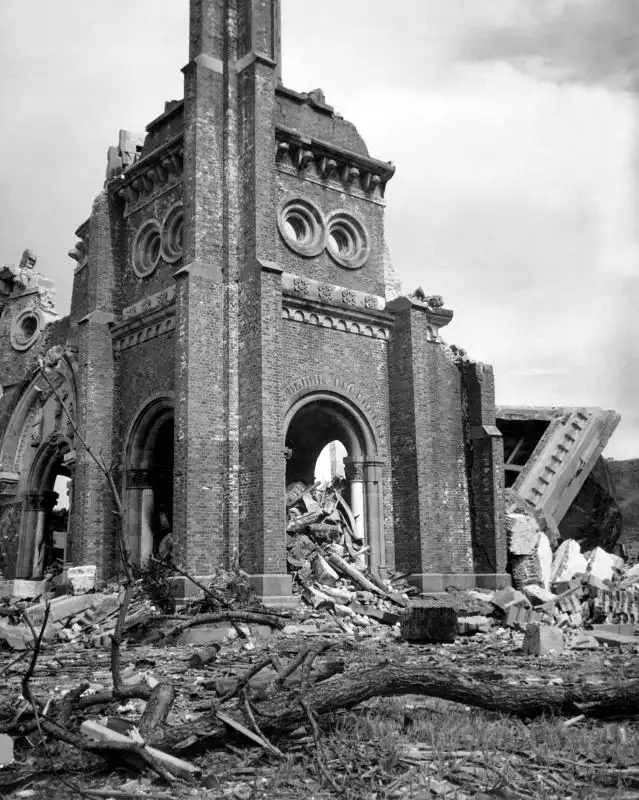
This photograph shows the ruins of the Urakami Catholic Cathedral in Nagasaki, Japan, following the atomic bombing of August 9, 1945. Once the largest Catholic cathedral in Southeast Asia, the church was completely destroyed by the nuclear explosion.
The image captures not only physical devastation, but the collapse of a century-old religious and cultural center.
The Urakami Cathedral Before 1945:
The Urakami Cathedral was completed in 1925 after decades of effort by Nagasaki’s Christian community. Before its destruction, it stood as:
-
The largest Catholic church in Southeast Asia
-
A symbol of Japan’s long and complex Christian history
-
The spiritual heart of the Urakami district
Nagasaki had one of the oldest Christian populations in Japan, dating back to the 16th century.
August 9, 1945: Total Destruction:
The atomic bomb “Fat Man” detonated approximately 500 meters from the cathedral, placing it near the hypocenter.
As a result:
-
The structure was instantly destroyed
-
Clergy and worshippers inside were killed
-
Stone walls collapsed, leaving only fragments
No conventional bombing could have erased such a massive structure so completely.
A Sacred Site Reduced to Ruins:
The ruins shown in the photograph represent:
-
The destruction of religious life
-
The vulnerability of cultural heritage in total war
-
The indiscriminate nature of nuclear weapons
Unlike military targets, the cathedral had no strategic value — yet it was annihilated in seconds.
Nagasaki’s Christian Community After the Bombing:
Survivors of the Urakami district faced:
-
Enormous civilian casualties
-
Loss of spiritual and community centers
-
Long-term displacement and radiation exposure
Despite this, the Catholic community eventually rebuilt. A new Urakami Cathedral was completed in 1959, standing today as a symbol of endurance rather than triumph.
Historical and Cultural Significance:
This image matters because it documents:
-
The destruction of the largest Catholic cathedral in the region
-
The intersection of nuclear warfare and civilian religion
-
The cultural cost of the atomic age
It shows that nuclear weapons do not only destroy cities — they erase identity and memory.
Photo Information:
-
📝 Subject: Ruins of the Urakami Catholic Cathedral
-
📍 Location: Nagasaki, Japan
-
📅 Date: August 1945
-
⛪ Significance: Largest Catholic cathedral in Southeast Asia before 1945
The ruins of the Urakami Cathedral stand as silent evidence that the atomic bombing of Nagasaki was not only a military event, but a cultural and spiritual catastrophe. In these broken stones lies the story of a community, a faith, and a city caught at the center of the nuclear age.
👉 Related: Atomic bombing of Nagasaki • Religious sites destroyed in WWII • Civilian impact of nuclear warfare
Related Pages

Tags
Category
Search
Categories
- Unidentified WWII Photos (14)
- World War II Photos 1937 (1)
- World War II Photos 1938 (1)
- World War II Photos 1939 (3)
- World War II Photos 1940 (5)
- World War II Photos 1941 (103)
- World War II Photos 1942 (60)
- World War II Photos 1943 (56)
- World War II Photos 1944 (77)
- World War II Photos 1945 (48)
- WWII and Postwar Photos 1946 (1)