Soviet NKVD soldier inspects the wreckage of a downed German Junkers Ju 88 reconnaissance aircraft near Moscow, 1941.
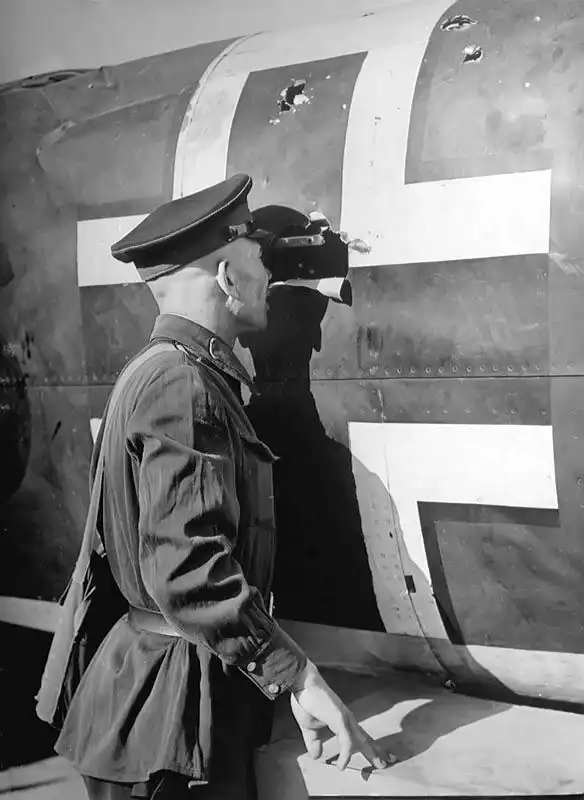
This World War II photograph captures a young soldier of the Soviet NKVD troops examining the wreckage of a German Junkers Ju 88 reconnaissance aircraft that had been shot down near Moscow during the summer of 1941. Leaning through a jagged hole torn in the aircraft's aluminum fuselage, the soldier carefully studies the interior of what had only recently been one of the Luftwaffe's long-range reconnaissance machines. The image, taken by renowned American photojournalist Margaret Bourke-White, reflects both the curiosity of Soviet troops and the growing confidence of Moscow's defenders.
The aircraft is believed to be the same Ju 88 F6+AK (Werknummer 0285) from the 2.(F)/122 Long-Range Reconnaissance Squadron featured in other photographs from this series. On 25 July 1941, it was intercepted by fighters of the Soviet 3rd Fighter Aviation Corps while conducting a reconnaissance mission over the Moscow–Kaluga sector. Forced down near Istra, the aircraft remained largely intact, allowing Soviet specialists to examine valuable equipment and gather intelligence before it was later transported to central Moscow for public display.
The Junkers Ju 88 was among the Luftwaffe's most versatile aircraft, serving as a bomber, reconnaissance platform, heavy fighter, and night fighter throughout the war. Reconnaissance versions carried specialized cameras, navigation instruments, and additional fuel for deep-penetration missions. During the opening months of Operation Barbarossa, such aircraft supplied German commanders with vital information on Soviet troop movements and defensive positions, making them high-priority targets for Soviet fighter pilots and anti-aircraft batteries.
Beyond its documentary value, this photograph captures a symbolic moment. The young NKVD soldier peers into the shattered remains of one of Germany's most advanced aircraft, representing the determination of Soviet forces to study, understand, and ultimately overcome the technology of the invading Wehrmacht. Images like this also demonstrated to both Soviet citizens and foreign audiences that the Luftwaffe was suffering real losses despite its early successes.
Historical background
Margaret Bourke-White was one of the first Western correspondents granted extensive access to the Soviet Union after the German invasion. During the summer of 1941 she photographed bomb damage in Moscow, Soviet air defense units, NKVD personnel, civilians, and captured German equipment. Her photographs published in LIFE magazine became some of the earliest visual records through which Western readers witnessed the Soviet struggle against Nazi Germany.
Technical characteristics of the Junkers Ju 88
- Type: Twin-engine reconnaissance aircraft (Ju 88 family)
- Crew: Four
- Powerplant: Two Junkers Jumo inline engines
- Maximum speed: Approximately 470–500 km/h (depending on variant)
- Operational range: Up to 2,500 km on reconnaissance missions
- Primary role: Strategic and tactical aerial reconnaissance
Technical photo data:
📍 Location: Moscow region, USSR
📅 Date: Summer 1941
📝 Event: Soviet NKVD soldier inspects the wreckage of a downed German Ju 88 reconnaissance aircraft
📷 Photographer: Margaret Bourke-White
Brief description
A Soviet NKVD soldier examines the wreckage of a German Ju 88 reconnaissance aircraft shot down near Moscow in the summer of 1941. The photograph, taken by Margaret Bourke-White, documents one of the early Luftwaffe losses during the Battle for Moscow.
Recommended literature
- Smith J., Kay A. German Aircraft of the Second World War.
- Murray Williamson. Luftwaffe.
- Bergström Christer. Barbarossa: The Air Battle, July–December 1941.
- Margaret Bourke-White. Shooting the Russian War.