German command tank Pz.Bf.Wg. III Ausf. H moves through a Russian village in occupied Soviet territory, spring 1942.
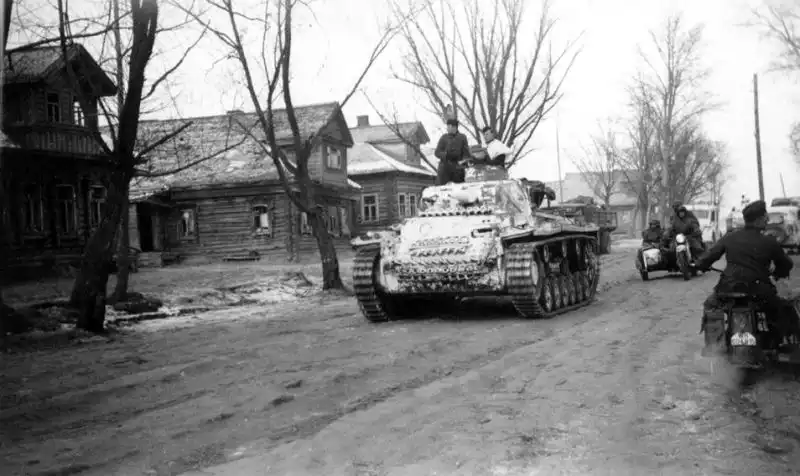
This World War II photograph shows a German Panzerbefehlswagen III Ausf. H command tank moving through a Russian village in occupied Soviet territory during the spring of 1942. Built on the chassis of the Pz.Kpfw. III Ausf. H, the vehicle served not as a standard battle tank but as a mobile command center, allowing German officers to direct armored formations during fast-moving operations on the Eastern Front.
Unlike ordinary Panzer III tanks, command versions carried additional radio transmitters, more powerful communication equipment, and extra antenna systems. To accommodate this equipment, early command tanks often sacrificed part of their ammunition storage or even mounted a dummy main gun. Maintaining reliable radio communication was one of the key strengths of German armored doctrine, enabling commanders to react quickly to changing battlefield conditions.
By the spring of 1942, German panzer forces were preparing for renewed offensive operations following the difficult winter fighting around Moscow. Although the Wehrmacht still retained considerable mobility and combat effectiveness, growing logistical problems, increasing Soviet resistance, and mounting equipment losses were beginning to reduce the operational flexibility that had characterized the opening months of Operation Barbarossa.
The peaceful appearance of the village contrasts sharply with the reality of occupation. Thousands of Soviet settlements found themselves under German military control during this period, becoming transit points for advancing formations, supply columns, and command vehicles such as the Panzerbefehlswagen III seen in this photograph.
Today, photographs of command tanks are valuable historical sources because they document an often-overlooked aspect of armored warfare. While combat tanks attracted most attention, specialized command vehicles formed the communications backbone of German panzer units and played a vital role in coordinating attacks, withdrawals, and battlefield logistics throughout the war.
Technical photo data:
📍 Location: Occupied Soviet territory (Russian village)
📅 Date: Spring 1942
📝 Event: German Panzerbefehlswagen III Ausf. H command tank operating during Wehrmacht offensive operations on the Eastern Front
📷 Photographer: Unknown German Army photographer
Historical background
The Panzerbefehlswagen III was developed to provide German armored commanders with a protected and highly mobile command post. Based on the reliable Panzer III chassis, it combined battlefield mobility with enhanced communications equipment, allowing commanders to coordinate multiple tank units while remaining close to the fighting.
The Ausf. H version incorporated improvements introduced on contemporary Panzer III tanks, including increased armor protection and wider tracks, making it better suited to the harsh terrain encountered on the Eastern Front. Although command tanks represented only a small percentage of Germany's armored vehicle fleet, they were indispensable for maintaining operational control during large-scale offensives.
Recommended reading:
- Karl-Heinz Frieser — The Blitzkrieg Legend
- Thomas L. Jentz — Panzer Tracts No. 3: Panzerkampfwagen III
- Steven J. Zaloga — Armored Champion
- David M. Glantz — When Titans Clashed
Related photos:
- Knocked-out Panzer III tank in North Africa
- Captured German Panzer III and StuG III in Red Army service
- Panzerbefehlswagen III command tank
- German armored command vehicles on the Eastern Front
- Wehrmacht communications and command tanks in WWII