Photograph of a Nazi occupation warning sign at Primorsky Boulevard in Sevastopol, 1944, showing the restrictions imposed on civilians.
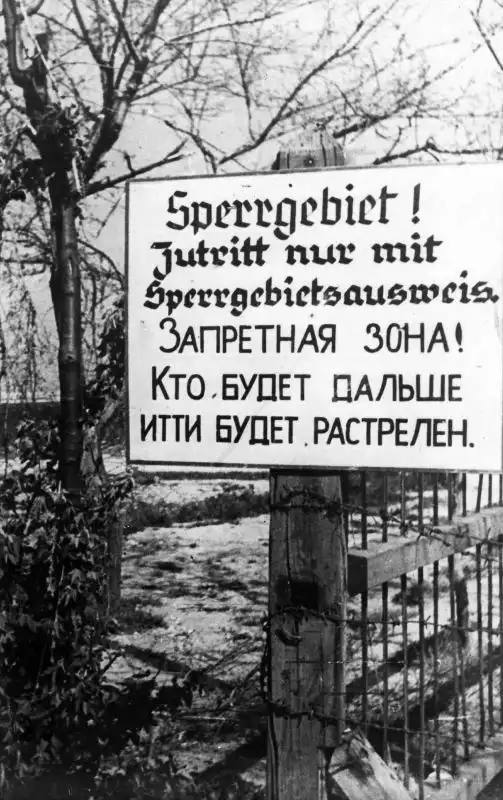
This World War II photograph documents one of the stark realities of the German occupation of Sevastopol. Captured after the city's liberation in 1944, it shows a warning sign erected by the occupying authorities at the entrance to Primorsky Boulevard, one of Sevastopol's best-known waterfront promenades.
The bilingual sign reads:
"Sperrgebiet! Zutritt nur mit Sperrgebietsausweis. Запретная зона! Кто будет дальше итти, будет расстрелян."
Translated into English, the message states: "Restricted area! Entry only with a special permit. Anyone proceeding further will be shot." Its wording illustrates the uncompromising methods employed by the German military administration to control access to strategically important locations.
After capturing Sevastopol in July 1942 following a prolonged siege, German and Romanian occupation authorities transformed much of the city into a heavily fortified military zone. The harbor, coastal batteries, administrative buildings, and major streets were placed under strict security. Access to many districts required special passes, while civilians risked arrest—or summary execution—for violating military regulations.
Primorsky Boulevard occupied a particularly important position overlooking Sevastopol Bay. During the occupation it served not only as a public promenade but also as an area adjacent to military facilities, observation points, and transportation routes supporting Axis operations throughout Crimea. Restricting civilian movement reduced the possibility of reconnaissance, sabotage, and contact with Soviet underground resistance groups.
The bilingual nature of the sign is equally revealing. German text was intended for Wehrmacht personnel and occupation officials, while the Russian warning ensured that local residents clearly understood the consequences of entering the prohibited zone. Similar notices appeared throughout occupied Soviet territory, reflecting a broader occupation policy based on military control and intimidation.
In the spring of 1944, the strategic situation changed dramatically. During the Crimean Offensive Operation, Soviet forces broke through German defenses, and on May 9, 1944, Sevastopol was liberated after fierce fighting. As the occupation ended, signs such as this disappeared, but photographs preserved valuable evidence of the everyday reality civilians endured under Axis rule.
The photograph was taken by the renowned Soviet photojournalist Yevgeny Khaldei, whose work documented many defining moments of the Eastern Front. Rather than depicting combat itself, this image captures another face of war—the administrative machinery of occupation, where a simple roadside notice carried the threat of immediate death.
Today, the photograph remains an important historical document illustrating how military occupation extended beyond the battlefield into the daily lives of ordinary people. It reminds viewers that control over cities was enforced not only with weapons, but also through regulations, checkpoints, permits, and constant intimidation.
Technical photo data:
📍 Location: Sevastopol, Crimea, USSR
📅 Date: 1944
📝 Event: German occupation, warning sign at Primorsky Boulevard
📷 Author: Yevgeny Khaldei
Recommended literature:
- John Erickson — The Road to Berlin
- David M. Glantz — The Soviet-German War 1941–1945
- Antony Beevor — The Second World War
- Christer Bergström — The Battle for Crimea 1941–1944
- Nazi restricted area Sevastopol
- Primorsky Boulevard occupation sign
- German military control 1944 Crimea
- Soviet liberation Sevastopol
- WWII warning sign photo