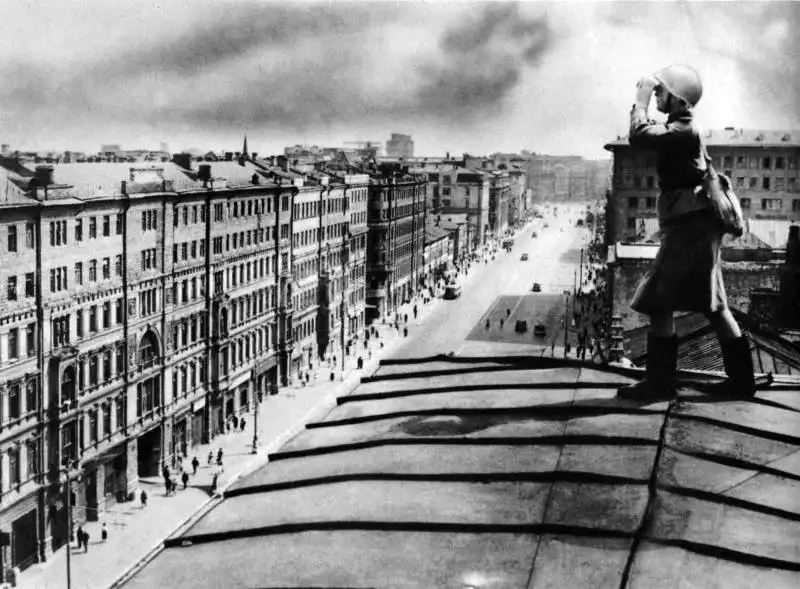
Female air defense observer scanning the sky from a Gorky Street rooftop in Moscow, 1941.
Eyes of Moscow: Women of the Soviet VNOS Air Warning Service
This wartime photograph captures a female air defense observer stationed on a rooftop along Moscow's Gorky Street in 1941. She served in the VNOS (Air Observation, Warning and Communications Service) — one of the most important components of the Soviet PVO (Air Defense Forces). Using an 8× field binocular, she searched the skies for approaching German aircraft during one of the most dangerous periods of the war.
The abbreviation VNOS comes from the Russian phrase Vozdushnoye Nablyudeniye, Opoveshcheniye i Svyaz, meaning Air Observation, Warning and Communications Service. Long before radar became widespread, this vast network relied on thousands of trained observers stationed on rooftops, towers, church steeples, and specially prepared observation posts. Their reports formed the first layer of Moscow's early-warning system.
Following the German invasion in June 1941, the Soviet capital rapidly expanded its air defense network. VNOS personnel identified aircraft by silhouette, engine sound, flight direction, and estimated altitude before transmitting reports through telephone and radio communications. Their warnings allowed anti-aircraft batteries, fighter aviation, searchlight units, and civil defense organizations to prepare for incoming Luftwaffe raids.
Women played a particularly important role within the VNOS system. Many observation posts were staffed almost entirely by female personnel, who worked long shifts in every season and under all weather conditions. Standing on exposed rooftops for hours required exceptional concentration, endurance, and discipline, as every unidentified aircraft could signal the beginning of another bombing raid.
The photograph, taken by renowned Soviet photographer Naum Granovsky, reflects both the vulnerability and determination of wartime Moscow. The observer's calm posture hides the enormous responsibility resting on her shoulders: a delayed or inaccurate report could mean precious minutes lost before air-raid sirens sounded across the city.
Today, images like this remind us that the defense of Moscow depended not only on fighter pilots and anti-aircraft guns, but also on countless observers whose sharp eyes and unwavering vigilance became the Soviet capital's first line of defense.
Technical Photo Data:
📍 Location: Gorky Street, Moscow, USSR
📅 Date: 1941
📝 Subject: Female VNOS (Air Observation, Warning and Communications Service) observer on rooftop air-defense duty
📷 Photographer: Naum Granovsky
Brief Historical Background
During World War II, the Soviet VNOS network consisted of thousands of observation posts spread across the country. Before radar coverage became sufficient, these observers provided the earliest warning of enemy aircraft, allowing the PVO to coordinate anti-aircraft artillery, fighter interception, searchlights, and civilian air-raid alarms. The system remained an essential part of Soviet air defense throughout the war.
Recommended Reading
- Steven J. Zaloga — Moscow 1941: Hitler's First Defeat
- Richard Overy — Russia's War
- David M. Glantz — Barbarossa: Hitler's Invasion of Russia 1941
- Roger R. Reese — Why Stalin's Soldiers Fought
- Female sky watchers WWII
- Moscow rooftop observation
- Early German invasion defenses
- Air warning and communications posts
- Women in home front defense USSR