Forced landing of a Soviet Polikarpov I-16 fighter aircraft in an open field, inspected by German soldiers during Operation Barbarossa, summer 1941.
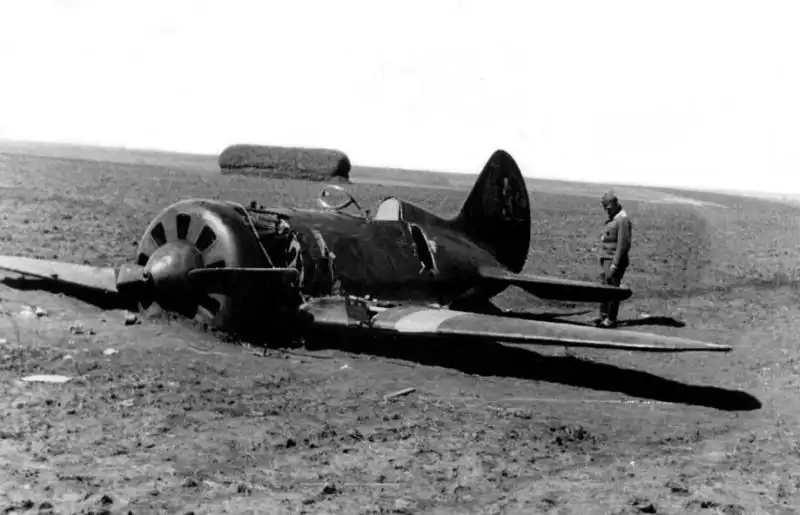
This World War II photograph shows a Soviet Polikarpov I-16 fighter after making a forced belly landing in an open field during the first months of Operation Barbarossa in the summer of 1941. A German soldier stands beside the aircraft as it is examined after falling into Wehrmacht hands. Emergency landings without extending the landing gear were common whenever mechanical damage, combat hits, or lack of suitable airfields left pilots with no safer alternative.
The Polikarpov I-16 was one of the most influential fighter aircraft of the 1930s. Entering service in 1934, it became the world's first low-wing monoplane fighter with retractable landing gear to be produced in large numbers. At the time of its introduction, the aircraft represented a revolutionary leap in fighter design, combining high speed, compact dimensions, and excellent maneuverability. It saw combat in Spain, Mongolia, China, Finland, and eventually throughout the Eastern Front.
By June 1941, however, the I-16 had largely reached the limits of its development. Although experienced Soviet pilots could still exploit its exceptional turning ability, the fighter was generally outclassed by newer German aircraft such as the Messerschmitt Bf 109F. Nevertheless, thousands of I-16s fought during the opening battles of the German invasion, carrying out interception, escort, reconnaissance, and even ground-attack missions despite mounting losses.
This image reflects the harsh realities of the air war during the summer of 1941. Many damaged Soviet aircraft were forced to land behind rapidly advancing German lines, where they became valuable intelligence sources for the Wehrmacht. German soldiers frequently photographed captured aircraft, while Soviet engineers carefully studied German machines whenever the opportunity arose. Both sides viewed enemy equipment as an important source of technical information.
Beyond its military significance, the photograph also illustrates the dramatic pace of the campaign during the first weeks of the invasion. Aircraft that had taken off from Soviet airfields only hours earlier could suddenly find themselves stranded in territory already occupied by advancing German forces, highlighting the fluid and chaotic nature of the front in 1941.
Technical photo data:
📍 Location: USSR
📅 Date: Summer 1941
📝 Event: Forced landing of a Soviet Polikarpov I-16 fighter during Operation Barbarossa
📷 Photographer: Unknown German Army photographer
Recommended reading:
- Gordon, Yefim & Dexter, Leonid. Polikarpov I-15, I-16 and I-153 Aces. Osprey Publishing.
- Maslov, Mikhail. Polikarpov I-16 Fighter. Midland Publishing.
- Bergström, Christer. Barbarossa – The Air Battle: July–December 1941. Chevron Publishing.